

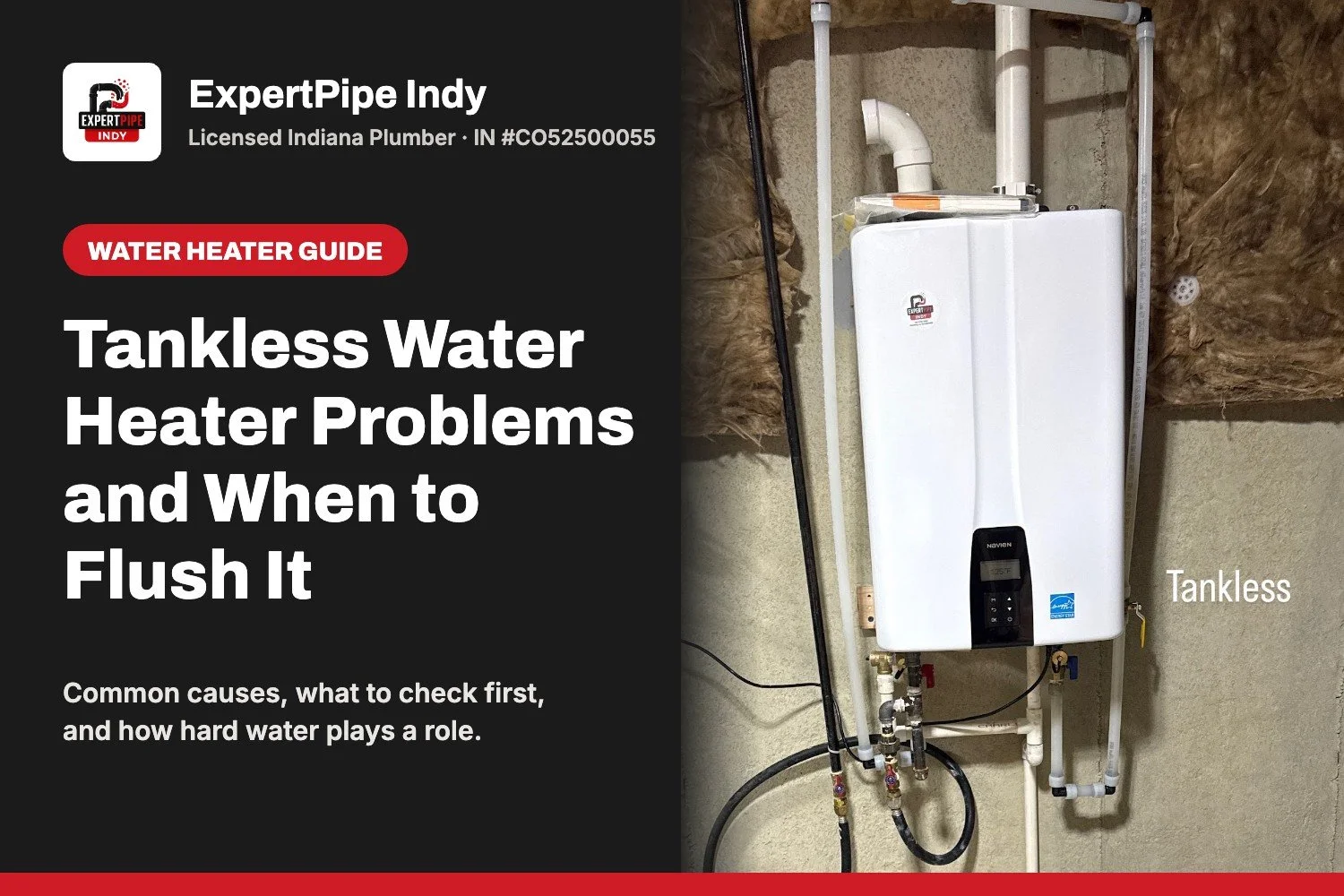
Tankless Water Heater Problems: Common Causes and When to Flush It
Lukewarm water, cold bursts or an error code on your tankless water heater? Here are the most common causes, what you can safely check first, and why yearly flushing matters with Central Indiana's hard water.
A tankless water heater is supposed to mean hot water that never runs out. So when the shower goes lukewarm, the water turns cold halfway through, or the unit flashes an error code and shuts down, it's frustrating. The good news is that most tankless problems we see in Carmel, Fishers, Westfield and North Indianapolis come down to a short list of causes, and several of them you can check yourself before calling anyone.
Common tankless water heater problems and what causes them
Lukewarm water or hot water that comes and goes
The most common cause in Central Indiana is scale. Our water is hard, and minerals build up inside the heat exchanger over time. Scale acts like insulation, so the burner works harder and the unit can't heat water as well as it should. Many units will show a warning or error code when scale gets bad, but plenty of homeowners just notice the water isn't as hot as it used to be. The fix is a descaling flush, covered below.
Hot water cuts out when the flow is low
A tankless heater only fires when enough water is moving through it. If you run a low-flow faucet at a trickle, the unit may not turn on at all, or it may shut off mid-use. Opening the tap a little more usually solves it. A clogged inlet filter screen can cause the same thing by cutting the flow before it reaches the burner.
Not enough hot water when two showers run at once
Every tankless unit has a limit on how many gallons per minute it can heat at once. In winter, the water coming into your home is much colder, so the unit has to raise the temperature further and can handle less flow. If hot water gets weak when the shower and dishwasher run together, the unit may be undersized for the house, it may be scaled up, or the gas line feeding it may be too small.
A burst of cold water in the middle of a shower
This is often called a "cold water sandwich." Someone turns the hot water off and back on, and the hot water still sitting in the pipe comes out first. Then a few seconds of cold water arrive while the burner fires back up, and then it's hot again. A short burst is normal for a tankless system. If it's long or getting worse, it's worth having us check the setup.
Error codes and the unit shutting down
Tankless heaters monitor themselves and shut down when something isn't right, like ignition trouble, a vent problem, overheating or a gas supply issue. Write down the code on the display and look it up in your owner's manual. Codes that keep coming back usually point to a problem that needs a plumber.
No hot water at all
Check the simple things first. A tankless unit needs electricity to run, so a tripped breaker, an unplugged cord or a power outage will stop it even on a gas model. Also make sure the gas valve to the unit is open and your other gas appliances are working.
What you can safely check before you call
Write down any error code on the display.
Check the breaker and make sure the unit has power.
Confirm the gas shutoff to the heater is open. If you smell gas, leave the house and call your gas company or 911 first.
Look at the vent and air intake outside the house. Leaves, snow, a bird's nest or a bush can block it.
Run one hot tap at a time, opened most of the way, to see if the problem is flow-related.
If your unit has an inlet filter screen and you're comfortable doing it, shut off the water to the heater and rinse the screen.
Anything involving the burner, gas line, venting or the inside of the unit is a job for a licensed plumber.
Flushing a tankless water heater: why it matters in hard water
Descaling is the most important maintenance a tankless heater needs. A pump circulates a descaling solution or food-grade white vinegar through the heat exchanger to dissolve mineral buildup, and then the unit is rinsed with fresh water. Most manufacturers recommend doing this about once a year. In hard-water areas without a water softener, it may need to be done more often.
A proper flush depends on isolation valves (service valves) on the hot and cold lines at the heater. Most newer installs have them. If yours doesn't, we can add them so future flushes are quick and clean.
A water softener helps a lot. Softer water means less scale in the heat exchanger and less frequent flushing. If you're seeing white crust on faucets and spotty dishes, read our guide to how hard water shortens water heater life or see our water softener and filtration service.
Repair or replace?
Many tankless problems can be fixed with a flush, a cleaned filter, a cleared vent or a part replacement. Replacement starts to make sense when the unit is older, the heat exchanger is badly scaled or leaking, or repair calls keep adding up. If you're on the fence about tankless in the first place, our post on whether tankless is worth it in Carmel and Indy walks through the pros and cons against a traditional tank.
How we handle tankless service
When you call ExpertPipe Indy about a tankless water heater, we check the unit, the gas supply, the venting and the water quality, and then explain what we found. You get options and an upfront price on site before any work starts. We install and service Navien tankless water heaters and Bradford White tank water heaters, and we pull the permit and haul away the old unit on replacements. If you have a written estimate from another licensed plumber, ask about our 10% price match.
Call or text (317) 731-3028, or visit our water heater repair and replacement page. We serve Carmel, Fishers, Westfield, Noblesville, Zionsville, Whitestown, Brownsburg, Cicero, McCordsville and North Indianapolis.
FAQ
How often should a tankless water heater be flushed?
About once a year for most homes. Homes with hard water and no softener may need it more often. Check your unit's manual for the manufacturer's schedule.
Why is my tankless water heater lukewarm in winter?
Incoming water is colder in winter, so the unit has to work harder and can heat less water at once. Scale buildup or an undersized unit makes it more noticeable.
Does a tankless water heater work during a power outage?
No. Even gas tankless units need electricity for the controls, fan and ignition.
Can I flush a tankless water heater myself?
If the unit has isolation valves and you follow the manufacturer's instructions, some homeowners do. If you're not sure, or the unit has no service valves, have a plumber do it so nothing gets damaged.
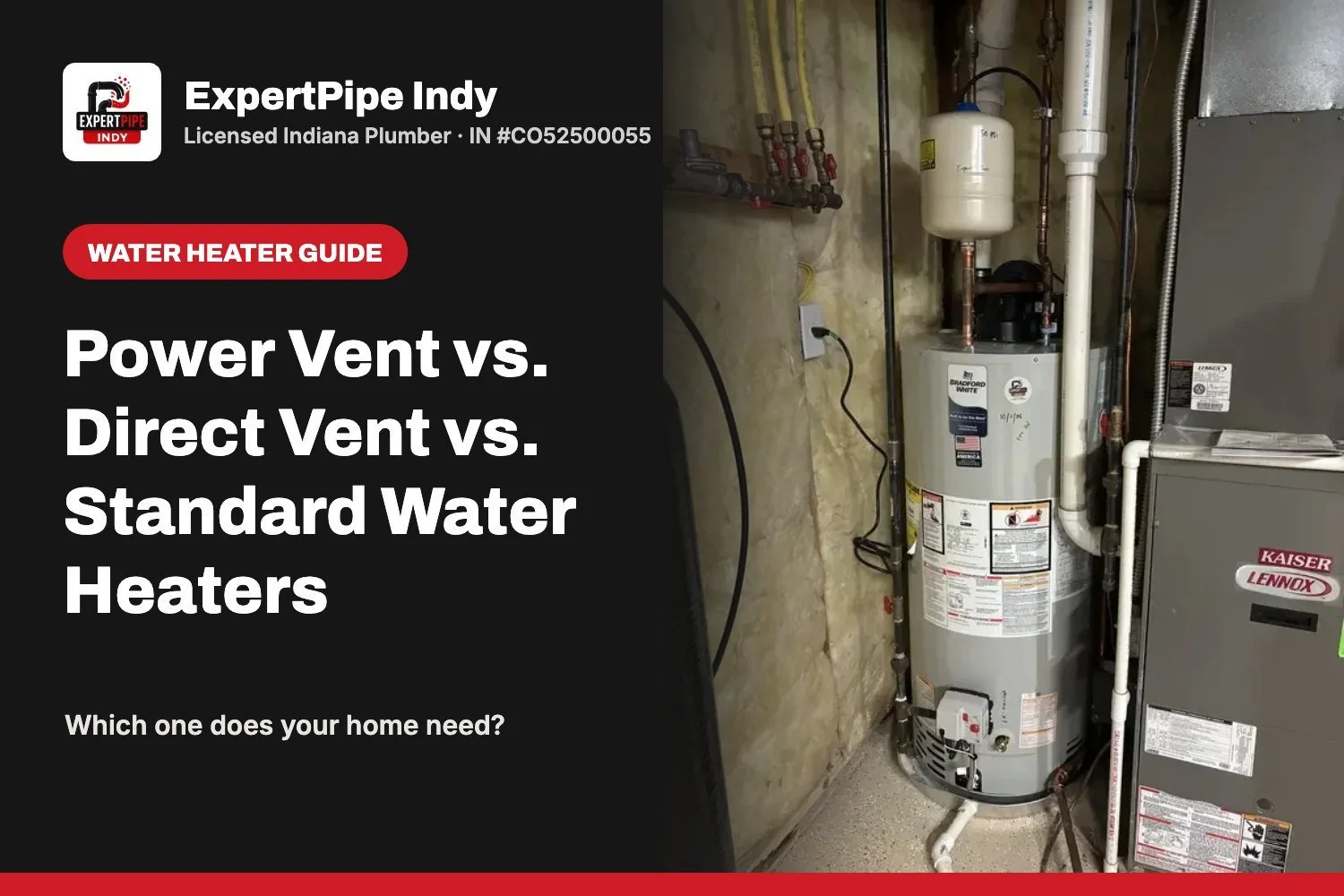
Power Vent vs. Direct Vent vs. Standard Water Heaters: Which Does Your Home Need?
Standard, power vent or direct vent? How each type of gas water heater vents, the pros and cons of each, and how to tell which one fits your Carmel, Westfield or Indianapolis home.
When people shop for a gas water heater, they think about gallons and gas vs. electric. But the first question we answer on a lot of jobs in Carmel, Westfield and North Indianapolis is how the heater gets rid of its exhaust. That one detail decides which water heaters will work in your home, where the heater can go, and what the install involves.
There are three common setups: standard (atmospheric) vent, power vent and direct vent. Here's how each one works and when it makes sense.
Standard (atmospheric) vent water heaters
This is the classic gas water heater. Hot exhaust rises on its own through a metal vent pipe on top of the tank and goes up into a chimney or a metal flue through the roof. There's no fan and no plug.
Good: Simple, quiet, no electricity needed, so you still have hot water during a power outage.
Watch out for: It needs a proper vertical vent path. If the exhaust doesn't draft well, it can spill back into the room instead of going up the flue.
A common issue in older North Indy and Carmel homes: the furnace gets upgraded to a high-efficiency model that vents through PVC out the side of the house. Now the water heater is the only thing left using a chimney that was sized for both. That can cause poor draft. Depending on what we find, the fix may be a chimney liner or switching to a power vent water heater.
Power vent water heaters
A power vent water heater has a fan (blower) on top of the tank that pushes the exhaust out through plastic vent pipe, usually PVC. Because the fan does the work, the vent can run sideways and exit through an outside wall. No chimney needed.
Good: Lets you put the water heater where a chimney can't reach, like a finished basement or a home where the chimney is no longer usable. The exhaust is cooler, so the vent pipe can be plastic instead of metal.
Watch out for: It needs a standard electrical outlet near the heater. If the power goes out, the fan stops and so does the hot water. You'll also hear the fan run while it heats.
We recently installed a Bradford White 50-gallon power vent in Westfield with an expansion tank and a water pressure check. You can see that job here: power vent water heater install in Westfield (46074).
Direct vent water heaters
A direct vent water heater is sealed. It pulls the air it burns from outside and sends the exhaust back outside, usually through a short vent on the wall right behind the heater. Many models don't need a fan or electricity.
Good: It doesn't use your indoor air for combustion, which makes it a good fit for closets or tight spaces. Often no outlet needed.
Watch out for: The vent run is short, so the heater usually has to sit close to an exterior wall. That limits where it can go.
There are also power direct vent models that combine the two: sealed combustion plus a fan for longer vent runs.
Quick comparison
Standard vent: uses a chimney or metal flue, no electricity, works in a power outage.
Power vent: fan pushes exhaust through PVC out a wall, needs an outlet, no hot water in a power outage.
Direct vent: sealed, uses outside air, short vent through the wall, usually no outlet needed.
Which one does your home need?
Most of the time, the answer comes down to what's already there and where the heater sits:
Your current heater vents into a chimney that drafts well: a standard vent replacement is usually the simplest choice.
Your furnace was upgraded and the water heater is alone in the chimney, or there's no chimney at all: a power vent is often the answer.
You're moving the water heater or finishing the basement: power vent or direct vent gives you more options for placement.
You're thinking about tankless: tankless gas units also vent through the wall. Read whether tankless is worth it in Carmel and Indianapolis.
One rule applies to all of them: every gas water heater needs to vent safely to the outside. Make sure you have working carbon monoxide detectors, and if you ever smell gas, leave the house and call your gas company or 911 first.
Signs your water heater vent needs a look
Rust, soot or scorch marks around the top of the water heater or the vent pipe
A loose or disconnected vent pipe
Moisture dripping on the top of the tank
A power vent fan that's louder than it used to be, or a heater that shuts off and shows an error
Your carbon monoxide detector going off
How we handle it
When you call ExpertPipe Indy for a water heater, we look at the venting first. We'll tell you which type fits your home and why, and you'll get a price before any work starts. We install Bradford White tank water heaters, including power vent models, and handle the permit where required.
Not sure what you have? Text us a photo of the top of your water heater and we'll take a look.
Call or text (317) 731-3028, or see our water heater repair and replacement page. We serve Carmel, Fishers, Noblesville, Westfield, Zionsville and North Indianapolis.

Sump Pump Repair or Replacement? Why We Install the StormPro 1/3 HP Cast-Iron Pump
Repair or replace your sump pump? Why we install the StormPro 1/3 HP cast-iron pump in Carmel, Fishers and Hamilton County basements, when to go bigger, and why to add a battery backup.
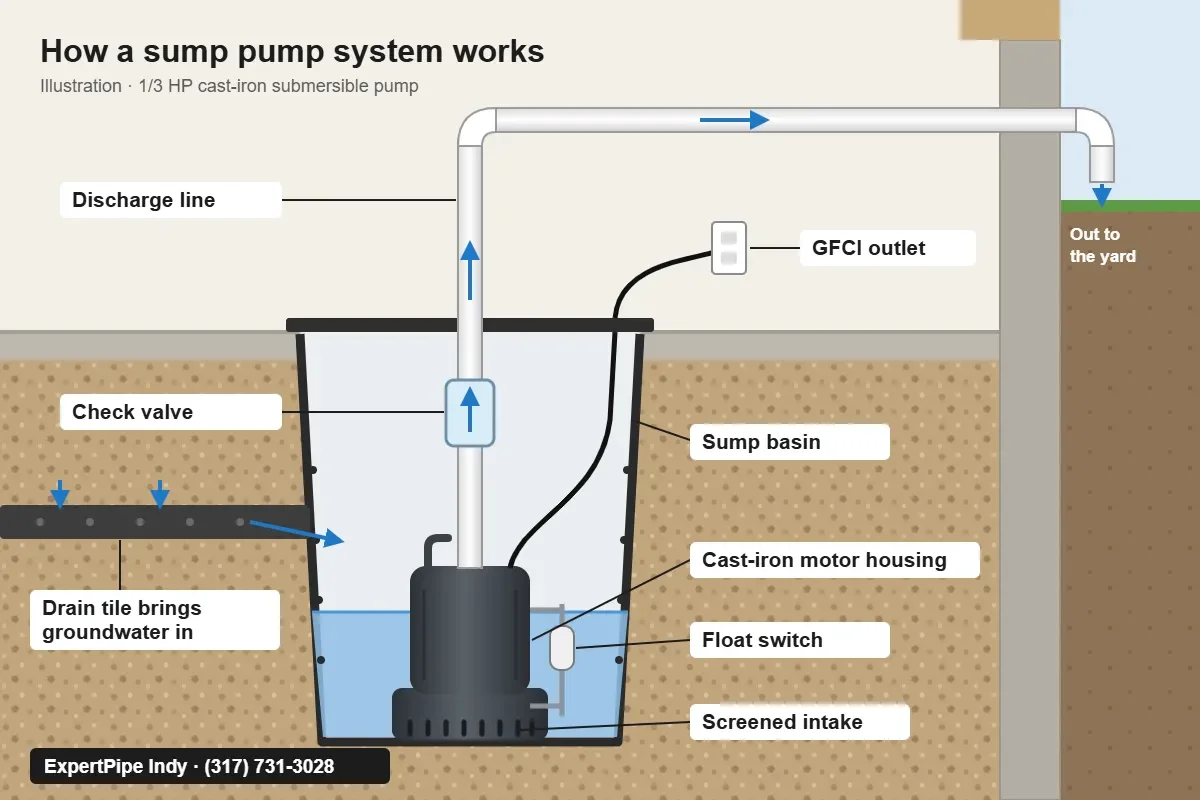
Illustration: how a sump pump system works. Groundwater flows through the drain tile into the basin, the float switch starts the cast-iron pump, and it pushes water through the check valve and out to the yard.
Searches for sump pump repair around Carmel, Fishers and Noblesville jump every time a storm system parks over central Indiana. If your pump is more than seven or eight years old, or you have never looked at it, now is the time to decide whether it needs a repair, a replacement or a backup before the next heavy rain.
Why we install the StormPro 1/3 HP cast-iron sump pump
For most Hamilton County basements, our go-to replacement is the StormPro BA33 series, a 1/3 HP cast-iron and stainless steel submersible pump. Here is why we like it:
Cast iron and stainless steel body. Metal housings shed heat better than plastic ones and hold up longer in a pit that runs often.
Moves real water. The manufacturer rates it at up to 68 gallons per minute with a maximum head of 25 feet, which covers the lift in a typical basement.
Handles debris. A vortex impeller passes solids up to 1/2 inch and a stainless steel screen keeps larger debris out.
Built-in protection. A carbon-ceramic mechanical seal and thermal overload protection help it survive long run cycles during a storm.
3-year manufacturer warranty.
Is 1/3 HP enough for my house?
For most homes in Carmel, Westfield and Fishers, yes. A 1/3 HP pump handles a normal water table and a standard 18 by 24 inch basin. We recommend stepping up to 1/2 HP when:
Your pump runs every few minutes during rain, or runs even in dry weather
The discharge pipe runs a long way or lifts water well above the basement floor
You are in a low spot or near a creek or pond where the water table sits high
We check the pit, the inflow and the discharge line on site and tell you which size fits before any work starts.
Repair or replace?
A stuck float, a failed check valve or a clogged screen can often be fixed. It is usually time to replace the pump when:
It is 7 to 10 years old or older
The motor hums but does not move water
It trips the breaker or runs hot
The housing is cracked or badly rusted
Add a battery backup
A lot of basement floods start when the power goes out during a storm, right when the primary pump is needed most. A battery backup pump sits beside the primary and takes over automatically. We can add one when we replace your pump or on its own.
Sump pump repair and replacement near you
We install and repair sump pumps in Carmel, Fishers, Noblesville, Westfield, Zionsville, Whitestown, Cicero, McCordsville, Brownsburg and North Indianapolis. Call or text (317) 731-3028, and we will give you options and a price on site before any work starts.
Sump pump installation and repair · Spring sump pump checklist

Spring Sump Pump Checklist: 10 Minutes That Can Save Your Basement
Spring in central Indiana means snowmelt, saturated ground and heavy storms, often all at once. That is when sump pumps work hardest and when a failure hurts most. A quick check now tells you whether your pump is ready.
The 10-minute test
Check the power. Make sure the pump is plugged into a working outlet (ideally a GFCI) and the cord isn't damaged.
Pour water into the pit. Slowly add a bucket of water until the float rises. The pump should turn on, empty the pit and shut off on its own.
Listen while it runs. Grinding, rattling or loud humming can mean a worn motor or debris in the impeller.
Clear the pit. Remove gravel, silt or debris that could jam the float or clog the intake.
Check the check valve. After the pump shuts off, water shouldn't flow back into the pit.
Follow the discharge line outside. Make sure it's connected, not crushed, and sends water at least several feet away from the foundation.
Test the battery backup, if you have one. Unplug the main pump and run the test again. Replace backup batteries every few years.
Signs it's time to replace your pump
It runs constantly, even when it hasn't rained.
It cycles on and off rapidly.
It's visibly rusted, or the motor is loud.
The pit has overflowed, even once.
It's more than about 7 to 10 years old.
Why a battery backup is worth it
The storms that fill your sump pit are the same storms that knock out power. A battery backup pump takes over when the power goes out or the main pump fails, which is exactly when you need it.
We can help
ExpertPipe Indy installs and replaces sump pumps and battery backup systems across Fishers, Noblesville, Carmel, Westfield and the rest of our service area. You'll get an upfront, flat-rate price before any work starts, and we'll beat any comparable written estimate by 10%.
Call or text (317) 731-3028, or request service online.

How to Keep Your Pipes From Freezing This Indiana Winter
Central Indiana winters bring stretches of single-digit nights and the occasional polar vortex. When water freezes, it expands, and a split pipe can release gallons into a wall or basement before anyone notices. Most frozen-pipe damage is preventable with an hour of prep in the fall.
Your fall checklist
Disconnect garden hoses. A hose left attached traps water in the outdoor spigot, which can freeze and crack the pipe inside the wall.
Shut off and drain outdoor spigots. If you have an interior shutoff for the hose bib, close it and open the outside tap to drain it.
Insulate exposed pipes. Foam pipe sleeves are cheap and fast to install. Focus on crawl spaces, unheated garages, attics and exterior walls.
Seal drafts near plumbing. Gaps around dryer vents, rim joists and pipe penetrations let cold air hit your lines.
Know where your main shutoff is. If a pipe bursts, shutting off the water in the first few minutes saves the most damage.
Check your sump pump and discharge line. A frozen discharge line can back water up into the basement during a winter thaw.
On the coldest nights
Keep the thermostat at 55°F or higher, even when you're away.
Open cabinet doors under sinks on exterior walls so warm air reaches the pipes.
Let a faucet on an outside wall drip slightly. Moving water is much harder to freeze.
Heading out of town? Consider shutting off the main and draining the lines, especially for a lake or seasonal home.
If a pipe freezes
Signs include no water or just a trickle from one faucet, frost on a visible pipe, or a strange smell from a drain. Open the faucet and warm the pipe gently with a hair dryer or space heater, starting near the faucet and working back. Never use an open flame.
If you can't find the frozen section, or the pipe has split, shut off the main water valve and call a plumber.
We can help
ExpertPipe Indy offers pipe insulation and winterization, frozen-pipe repair and leak detection across Carmel, Fishers, Noblesville, Westfield, Zionsville and North Indianapolis. You get an upfront, flat-rate price before any work begins.
Call or text (317) 731-3028, or request service online.

7 Warning Signs Your Well Pump or Septic System Needs Attention
If your home is on a private well and septic system, you are your own water utility. Around Zionsville, Cicero, Whitestown and much of rural Hamilton and Boone counties, that is common. The upside is independence. The downside is that small problems stay hidden until the water stops or the drains back up.
Here are the signs worth calling about early, before they turn into an emergency.
Well pump warning signs
1. Water pressure that drops or surges. Weak showers, or pressure that swings high and low, often point to a failing pressure switch, a waterlogged pressure tank or a pump that is wearing out.
2. The pump runs constantly or clicks on and off. A pump that cycles every few seconds (called short-cycling) is usually a pressure tank problem. It wears the pump out fast and drives up your electric bill.
3. Sputtering faucets or air in the lines. Spitting taps can mean the water level in the well has dropped, or there is a leak in the drop pipe.
4. Cloudy, gritty or discolored water. Sediment can mean a failing pump, a damaged screen or a well that needs service. New tastes or smells are also worth a water test.
Septic warning signs
5. Slow drains throughout the house. One slow sink is usually a clog. Every drain slowing down at once points to the septic tank or the line to it.
6. Gurgling pipes or sewage odors. Gurgling toilets and a sewer smell inside or near the tank mean the system is not venting or draining the way it should.
7. Soggy ground or unusually green grass over the drain field. Standing water or extra-lush patches above the tank or field can mean the system is backing up or overloaded.
What you can do now
Note when the problem happens: after showers, laundry or heavy rain.
Spread out laundry and dishwasher loads to go easy on the septic system.
Keep grease, wipes and "flushable" products out of drains.
Don't drive or park over the tank or drain field.
When to call a plumber
Call right away if you have no water, sewage backing up, or a pump that won't shut off. For slower changes, a diagnosis now is almost always cheaper than a failed pump or a flooded basement.
ExpertPipe Indy repairs and replaces well pumps, pressure tanks and pressure switches, and handles septic line repairs and backups. You get an upfront, flat-rate price before any work starts, and every job carries a 12-month workmanship warranty.
Call or text (317) 731-3028, or request service online.

What Does a Plumber Cost in Indiana? What Shapes the Price
"How much is this going to cost?" is usually the first thing a homeowner wants to know, and it's a fair question. The honest answer is that it depends on a few things your plumber can only see once they're standing in front of the problem. Here's what those things are, and how we handle pricing at ExpertPipe Indy so you're never left guessing.
What drives the cost of a plumbing job
Two jobs with the same name can look very different once the cabinet door is open or the drywall is off. These are the factors that make the biggest difference.
Access. A shutoff valve in an open basement is a quick swap. The same valve behind a finished wall, in a crawlspace or under a slab takes more time and care.
The pipe in your home. Tying into PEX in a newer Westfield build is a different job from working on galvanized steel or cast iron in a 1950s North Indianapolis home.
Parts and equipment. A faucet cartridge, a pressure regulator and a new water heater are very different purchases, and the size and type you need matter.
Code requirements. Some work needs a permit, an expansion tank, updated venting or other items to meet current code. We take care of those and explain why they're needed.
Condition of what's there. Corroded fittings, seized valves or years of hard water scale can turn a simple repair into a bigger one.
Timing. A scheduled visit is easier to plan than a burst pipe at night, and urgent work can affect the price.
Why older and newer homes price differently
Around Central Indiana, the age of a house tells us a lot before we pull into the driveway. Older homes in Broad Ripple, Meridian-Kessler and Nora may still have clay or cast-iron sewer lines, galvanized supply pipe and tight crawlspaces. Work there can take longer because old parts don't always come apart cleanly.
Newer neighborhoods in Carmel, Fishers and Westfield usually have PEX and modern fixtures, which are easier to work on. They bring their own items, like sump pumps, pressure regulators and expansion tanks that need attention as they age. Homes on well water in the outer parts of Hamilton, Boone and Hendricks counties add pumps, pressure tanks and switches to the picture.
How we price your job
When your ExpertPipe Indy plumber arrives, they look at the problem first, explain what's going on in plain language and give you your options with a price for each one. No work starts until you approve it.
If a safe, lasting repair makes sense, that's the first option you'll hear about.
If replacement is the better value, we'll show you why, whether it's age, condition or a code issue.
You'll know what's included, such as permits and haul-away of the old unit on a water heater replacement.
Some simple jobs can be priced over the phone. Text a photo and a short description to (317) 731-3028 and we'll let you know if yours is one of them.
Ways to keep the cost of plumbing down
A few habits genuinely help.
Catch problems early. A dripping supply line or a water heater that has started to rumble is easier to deal with before it leaks.
Know where your main shutoff is. Stopping water fast limits damage and cleanup.
Treat hard water. Hamilton County water is hard, and it wears out water heaters, faucets and valves early. A softener protects all of them.
Group small jobs. If you have a running toilet and a slow drain, mention both when you book so one visit covers them.
We also have a few standing offers: $500 off any tankless water heater installation and $50 off any tank water heater installation. If you already have a comparable written estimate from another licensed plumber, our 10% price match beats it by 10%. Offers can't be combined with the price match.
Questions worth asking before you approve work
What's causing the problem?
What are my repair and replacement options?
Is this a permanent fix or a temporary one?
What's included, and does it need a permit?
What happens if I wait?
We're glad to answer every one of these. We'd rather you understand the job than feel rushed into it.
When to call us
If you've got a leak, a water heater on its way out or a drain that won't clear, call or text and we'll get someone out, usually the same day or the next. You can see real jobs on our recent work page, or read more about water heater repair and replacement.
FAQ
Can you tell me the cost over the phone?
For some simple jobs, yes. For most work the price depends on what your plumber finds, so we give you options and a price on site before anything starts.
Will I be charged for work I didn't approve?
No. Your plumber explains your options and the price for each one first, and nothing begins until you say yes.
Why can a repair in an older home take longer?
Older homes often have galvanized or cast-iron pipe, tight access and fittings that have been in place for decades. Those take more care to open up and connect to safely.
Do you offer a price match?
Yes. Show us a comparable written estimate from a licensed plumber and we'll beat it by 10%. The details are on our price match page.
Is your work guaranteed?
Yes. Every job comes with a 12-month workmanship warranty, and our techs are licensed, insured and background-checked.
Want a clear price on your plumbing job? Call or text (317) 731-3028, or request service online.

Why Your Pipes Make Noise: Banging, Whistling and Rattling
Pipes are supposed to be quiet. When yours start banging, whistling or ticking, they're telling you something about pressure, flow or how the pipe is held in place. Most of these sounds have simple causes, and the sooner you pin one down, the easier it is to fix.
Banging when a faucet or appliance shuts off
A loud thud right after you close a faucet, or when the washing machine or dishwasher finishes filling, is called water hammer. Water moving through the pipe stops suddenly, and that energy slams through the line.
Washers and dishwashers are frequent culprits because their valves snap shut instantly. High water pressure makes it worse, and some parts of Central Indiana see city pressure high enough that a pressure regulator is needed to keep it in check.
Water hammer is worth fixing even if the noise doesn't bother you. Every bang stresses joints and fittings, and over time that can loosen a connection inside a wall.
Common fixes include water hammer arrestors at the washer or dishwasher, repairing or replacing a failed pressure regulator, and securing pipes that move when the water stops.
On a well system, a clunk when the pump shuts off can come from a worn check valve.
Whistling or squealing while water runs
A high-pitched whistle usually means water is squeezing through a spot that's too narrow. Hard water is a big reason for that around here. Across Hamilton County, mineral scale builds up inside valves, fill valves and faucet cartridges until the opening is small enough to sing.
A whistling toilet usually needs a new fill valve.
A squeal at one faucet points to a worn washer or cartridge, or a partly closed stop valve under the sink.
A whistle through the whole house can mean a failing pressure regulator or a main shutoff that isn't fully open.
Rattling, ticking and knocking
A rattle while water runs usually means a pipe is loose and vibrating against framing or ductwork. Clamps and straps work loose over the years, especially in basements and crawlspaces where pipes run a long way between supports.
A tick-tick-tick after you run hot water is usually the pipe expanding as it heats and shrinking as it cools, rubbing against wood or a tight hole as it moves. You'll often hear it in newer Carmel, Fishers and Westfield homes plumbed with PEX, which expands more than copper. It's mostly harmless, though adding room at the supports or a little padding can quiet it.
Our freeze-thaw winters make both of these more noticeable, since pipes near outside walls see bigger temperature swings.
Gurgling from drains
Gurgling is a drain sound, not a supply sound. It happens when air can't move freely through the drain system, so water pulls air through the nearest trap instead.
A gurgling sink after the tub drains often means a partial clog or a blocked vent.
Gurgling in several fixtures at once, especially low ones in a basement, can point to a problem in the main sewer line.
In older North Indianapolis homes with clay sewer lines, tree roots are a common cause.
What you can safely check yourself
Note which fixture or appliance sets off the noise, and whether it happens on hot, cold or both.
Make sure the main shutoff and the stop valves under sinks are fully open.
Look along exposed pipe in the basement for loose straps or spots where pipe touches framing.
Watch for damp spots, drips or stains near where the noise comes from.
Leave the pressure regulator alone, and don't force a stuck valve. Both can create a leak you didn't have before.
When to call us
Call if the noise is loud, happens every time you use water, started suddenly, or comes with low pressure, leaks or a slow drain. Your plumber will track down the cause and give you options and a price before any work starts. For banging and pressure problems, see our leak detection and repair service, and for gurgling drains, our drain cleaning and repair page.
FAQ
Is water hammer dangerous?
Not right away, but it's hard on your plumbing. Repeated shocks loosen fittings and can eventually cause a leak, often somewhere you can't see. It's worth fixing early.
Why do my pipes tick when the heat or hot water is on?
That's thermal expansion. The pipe grows slightly as it warms and rubs against framing or a strap. It's usually harmless, and giving the pipe room to move quiets it.
Can hard water make my pipes louder?
Yes. Scale narrows valves and fixtures, which speeds up the water and causes whistling. A water softener keeps new scale from forming.
My new house has noisy pipes. Is something wrong?
Not necessarily. Newer homes can have high incoming pressure, fast-closing appliance valves and PEX that moves as it heats. A quick look usually finds a simple fix.
Will pipe noise go away on its own?
Rarely. Loose supports get looser and scale keeps building, so most noises get louder over time.
Hearing something odd in your walls? Call or text (317) 731-3028, or request service online.

Low Water Pressure in Indiana Homes: Causes and Fixes
A weak shower or a faucet that takes forever to fill a pot gets old fast. The good news is that low water pressure almost always has a findable cause, and where the problem shows up tells you a lot about what it is. Here's how to narrow it down.
Pressure or flow?
Plumbers separate these two, and it helps if you do too. Pressure is how hard the water is pushing in the pipes. Flow is how much water actually comes out. A house can have plenty of pressure at the meter and still have poor flow at the shower because something is in the way.
In Central Indiana, restricted flow is the more common problem, and hard water is usually part of the story.
Start with where it's happening
Only one faucet or shower
This is the easiest case. Minerals from our hard water collect in faucet aerators and showerhead screens until only a trickle gets through.
Unscrew the aerator, rinse out the grit and soak it in vinegar if it's crusty.
Soak or replace a scaled-up showerhead.
If that doesn't help, the faucet cartridge or the stop valve under the sink may be worn or partly closed.
Only on the hot side
If cold water runs strong but hot is weak, look at the water heater. Sediment builds up in tank heaters here, and scale can also collect in the fittings on top of the tank or in the heat exchanger of a tankless unit. A broken dip tube can send plastic bits into the lines and clog aerators. Flushing helps in some cases, and your plumber can tell you whether the heater is worth servicing.
The whole house
When every fixture is weak, the cause is usually upstream of everything.
A main shutoff that isn't fully open, often after someone turned it off for a repair.
A failing pressure regulator. Many homes have one where the water line enters, and they wear out with age.
Old galvanized pipe. In older North Indianapolis homes, galvanized steel rusts and scales on the inside until the opening is a fraction of its original size.
A hidden leak. Water escaping somewhere lowers what reaches your fixtures.
Work on the city main. If neighbors notice the same thing, it may be temporary and outside your home.
Homes on well water
Outside the city lines in Hamilton, Boone and Hendricks counties, many homes run on a well, and pressure depends on the pump, the pressure tank and the pressure switch working together. Pressure that surges and drops, or a pump that clicks on and off constantly, often points to a waterlogged pressure tank or a switch that needs adjustment. Weak pressure along with sputtering or cloudy water can mean the pump itself is struggling. Our well pump service covers all three pieces.
Quick checks before you call
Is it one fixture, hot only, or the whole house?
Did it drop suddenly or fade over months?
Is the main shutoff valve fully open?
Are neighbors having the same problem?
Do you see damp spots, hear running water with everything off, or notice a higher water bill?
Skip adjusting the pressure regulator yourself, and don't open pipe connections. Those are easy ways to create a leak.
How we fix it
Your plumber tests the pressure, checks the likely spots and explains what they found. Then you get your options and a price before any work starts. Depending on the cause, that might mean a new aerator or cartridge, a valve or regulator replacement, water heater service, a leak repair, or replacing a section of old galvanized pipe. When most of a house is still on galvanized, whole-home repiping may be the lasting fix, and we'll explain why if that's the case.
If hard water caused the problem, a softener keeps it from coming back.
When to call us
Call right away if pressure dropped suddenly, both hot and cold are affected, or you suspect a leak. Slow, gradual loss can be scheduled. Our leak detection and repair team can find a hidden leak without guesswork.
FAQ
Why is my water pressure low only on hot water?
The problem is usually at the water heater or the hot lines leaving it. Sediment, scaled fittings or a broken dip tube are common causes in hard-water areas like ours.
Can a booster pump fix low pressure?
Sometimes, but a booster won't clear a clogged pipe or a bad regulator. Finding the actual restriction first is almost always the better fix.
Will a water softener raise my pressure?
It won't remove scale that's already in the pipes, but it stops new buildup. That keeps fixtures and valves flowing well after they're cleaned or replaced.
Is sudden low pressure an emergency?
It can be. A sudden drop may mean a broken pipe or a failed regulator, so check for water where it shouldn't be and call us. If you find a leak, shut off the main.
How do I know if I have galvanized pipe?
Look where the water line enters the house. Galvanized is dull gray steel with threaded fittings. It's common in homes built before the 1960s.
Tired of a weak shower? Call or text (317) 731-3028, or request service online.

What Counts as a Plumbing Emergency in Indiana?
Some plumbing problems can wait until Monday. Others get worse by the minute. Knowing the difference helps you protect your home and avoid a middle-of-the-night call you didn't need to make.
Call right away for these
Water you can't stop. A burst pipe, a failed supply line or water coming through a ceiling. Shut off the main and call.
A frozen or burst pipe in winter. A frozen line can split and flood once it thaws, so it needs attention before that happens.
A leaking water heater. Water pooling around the base usually means the tank is failing and won't get better.
Sewage backing up. Waste coming up in a tub, shower or basement floor drain is a health risk and needs fast attention.
No water at all. Losing all water can mean a major leak, a frozen service line or, on a well, a failed pump.
A sump pump that has stopped during heavy rain. A basement can take on water quickly in a spring storm.
If you smell gas
Don't treat this as a plumbing call first. Leave the house right away, don't flip switches or use anything that could spark, and call your gas utility or 911 from outside. Once the utility says it's safe, we can repair gas lines and gas water heater connections. Our gas line service page has more.
These can usually wait for a scheduled visit
A slow drain that still drains, as long as nothing is backing up
A dripping faucet
A toilet that runs but isn't overflowing
Lukewarm water, or hot water that runs out sooner than it used to
A small, steady drip under a sink you can catch with a bucket and shut off at the stop valve
Not sure which list you're on? Text a photo to (317) 731-3028. Texts are answered 24/7, and we'll tell you whether it can wait.
What to do while help is on the way
Shut off the water. Use the stop valve at the fixture if there is one, or the main shutoff. In most Central Indiana homes the main is in the basement or crawlspace where the line comes through the wall, or in a utility closet in slab homes.
Turn off the water heater if it's leaking. For electric, switch off the breaker. For gas, turn the control to the off or pilot setting. Then close the cold water valve on top of the tank.
Stop using drains if sewage is backing up. That includes toilets, the washer and the dishwasher.
Keep safe around water. Stay out of standing water near outlets or appliances.
Take photos of the damage for insurance, then move what you can out of the way.
Why Indiana weather causes so many emergency calls
Our winters swing between freezing nights and mild days, which is hard on pipes in outside walls, crawlspaces and unheated garages. Hose bibs are a common freeze point when a hose is left attached. When temperatures drop into single digits, open cabinet doors under sinks on outside walls and let a faucet drip.
If a pipe does freeze, open the faucet it feeds and warm the pipe slowly with a hair dryer or space heater kept at a safe distance. Never use an open flame. If you can't find the frozen spot, or the pipe has split, call us.
Spring brings heavy rain and high groundwater, which is when sump pumps in basements across Carmel, Fishers and Westfield work hardest. A battery backup keeps the pump running if the power goes out during a storm.
When to call us
For anything on the call-right-away list, call (317) 731-3028 instead of texting so we can talk you through shutting things off while we're on the way. Our emergency plumbing page explains how we handle urgent calls, and our sump pump service covers repairs and battery backups.
FAQ
Is no hot water an emergency?
It's urgent, especially in winter or with small kids at home, but it's rarely dangerous. If the tank is leaking, treat it as an emergency and shut off the water and power or gas to the heater.
Should I call my insurance company or a plumber first?
Stop the water first, then call a plumber to stop the source. Call your insurance company after that, with photos of the damage.
Where is my main water shutoff?
Usually where the water line enters the house, often in the basement or crawlspace near the front wall. In slab homes, check a utility closet or near the water heater. It's worth finding before you need it.
Can a frozen pipe wait until morning?
Only if it hasn't split and you can keep the area warm. Open the faucet, warm the space and call first thing. If you see water or hear it running, shut off the main and call right away.
Can you fix it the same day?
Most calls are handled the same day or the next, and many emergency repairs are finished on the first visit. Your plumber gives you options and a price before work starts.
Water where it shouldn't be? Call (317) 731-3028 now, or visit our emergency plumber page.

How to Choose a Plumber Near You in North Indianapolis
When something breaks, most people grab their phone and search "plumber near me." You'll get a long list back. A few minutes of checking helps you pick someone you'll be glad you called, and in North Indianapolis it pays to find a plumber who knows the older homes here.
Start with the license
In Indiana, plumbing contractors are licensed through the state's Professional Licensing Agency, and you can look up a license online in a minute. It's the first thing worth checking. ExpertPipe Indy holds Indiana plumbing contractor license IN #CO52500055.
While you're at it, ask whether the company is insured and whether its techs are background-checked. You're letting someone into your home, so that should be an easy yes.
Read reviews for details, not just stars
A high rating is a good start. The details in the reviews tell you more.
Do people mention the plumber explaining the problem clearly?
Did the job cost what they were told it would?
Did the tech show up when promised and leave the work area clean?
Are there reviews from your part of town or for the kind of job you need?
Do people say they've used the company more than once?
We're proud to have 5.0 stars on Google from more than 100 homeowners, and you'll see those themes come up again and again.
Look for a clear price before work starts
You should know what you're paying for before anyone picks up a wrench. A good plumber looks at the problem, explains it in plain language and gives you options with a price for each.
That's how we work. Your plumber gives you options and a price on site, and nothing begins until you approve it. Some simple jobs can be priced over the phone. If you already have a written estimate from another licensed plumber, our 10% price match beats it by 10%.
Choose someone who repairs first
Ask how the plumber decides between repair and replacement. A sensible answer sounds like this: if a safe repair will last, do that; if replacement is the better value, explain why. That's our approach on every call, whether it's a water heater, a faucet or a sewer line.
Pick a plumber who knows North Indy homes
North Indianapolis has a lot of character, and a lot of older plumbing. Homes in Broad Ripple, Meridian-Kessler, Meridian Hills, Nora and Butler-Tarkington often have:
Clay or cast-iron sewer lines that can crack or let tree roots in
Galvanized supply pipe that slowly closes up with rust and scale
Basements with floor drains, laundry tubs and sump pumps
Past remodels layered on top of original plumbing
A plumber who works in these neighborhoods regularly knows what to look for and how to work on older materials carefully. When a sewer line needs digging, Shawn and his excavation crew handle it, and Lucas, our master plumber, is on the bigger projects.
Check how they communicate and back their work
Being able to text a photo of a leak or a water heater label saves time on both ends. Texts to (317) 731-3028 are answered 24/7, and we can often tell you from a photo what you're dealing with and whether it can wait.
Also ask what happens if something isn't right after the job. Every ExpertPipe Indy job is backed by a 12-month workmanship warranty.
Five things to know before any plumber arrives
A few minutes of prep makes any plumbing call faster and can limit the damage while you wait.
Where your main shutoff is. In most basement homes it's on the front wall where the water line enters. In slab homes, check the utility closet or garage. Tag it so anyone can find it.
Your water pressure. A simple gauge on an outdoor faucet tells you. Most homes do well at 50 to 70 PSI. Above 80 PSI, pipes, fixtures and appliances wear out faster.
What your supply lines are made of. Rubber hoses on washing machines and toilets get brittle. Braided stainless lines hold up much better.
Where your sewer cleanout is. It's often a capped pipe near the foundation or in the basement floor. Knowing where it is speeds up any drain call.
How old your water heater is. The date is usually coded into the serial number on the label. If it's past ten years, start planning.
When to call us
We work across North Indianapolis from our office in Carmel, just up the road, and we also cover Carmel, Fishers, Noblesville, Westfield, Zionsville, Whitestown, Brownsburg, Cicero and McCordsville. Learn more on our North Indianapolis plumber page, or see real jobs on our recent work page.
FAQ
How do I check a plumber's license in Indiana?
Use the Indiana Professional Licensing Agency's online license lookup and search by name or license number. Our number is IN #CO52500055.
Should I get more than one estimate?
For bigger jobs like a sewer line or repiping, it's reasonable. If you do, bring us the written estimate and our price match will beat a comparable one from a licensed plumber by 10%.
Do you work on older homes with cast-iron or clay pipe?
Yes, regularly. Much of North Indianapolis still has original sewer and drain lines, and we repair and replace them with care for the rest of the house.
How quickly can you get to North Indianapolis?
Most calls are handled the same day or the next. If water is actively leaking, call so we can help you shut it off while we're on the way.
What should I have ready when I call?
A short description of the problem and a photo if you can. For a water heater, a picture of the label helps us bring the right parts.
Looking for a plumber in North Indy? Call or text (317) 731-3028, or request service online.

How Hard Water Shortens Water Heater Life in Indiana
If your water heater gave out sooner than you expected, the water itself is a likely suspect. Much of Central Indiana, Hamilton County included, has hard water, and heating it is exactly what makes those minerals cause trouble. Here's what happens inside the heater and what you can do about it.
What heat does to hard water
Hard water carries dissolved calcium and magnesium. At cold-water temperatures most of it stays in solution. Heat it up and those minerals come out as solid scale and sediment, and the hotter the water, the faster that happens.
That's why the water heater takes the brunt of it. Your pipes and faucets see some buildup, but the heater is where the water gets hot every day, all year.
Inside a tank water heater
In a tank heater, loose sediment settles to the bottom and builds into a layer over the years. That layer causes a chain of problems.
Popping and rumbling. Water trapped under the sediment boils in little bursts. That noise is the most common early sign.
Wasted energy. On a gas heater, the burner has to push heat through the sediment, so it runs longer. On an electric heater, the lower element can get buried in scale and burn out.
Less hot water. Sediment takes up room in the tank, and scaled elements heat more slowly.
Stress on the tank. Hot spots under the sediment are hard on the tank lining, and the anode rod wears out faster. Once the steel tank starts to rust through, it can't be repaired.
Tankless heaters need care too
Tankless heaters don't collect a pile of sediment, but scale coats the inside of the heat exchanger. As it builds, you may see weaker hot water flow, temperature swings or error codes, and the unit has to work harder. In hard water, a tankless heater should be descaled regularly, typically once a year, and a softener ahead of it helps a lot. We install and service Navien tankless units and can set up a descaling routine for yours.
It isn't just the water heater
The same minerals wear on anything that heats or meters water:
Dishwashers and washing machines, where scale coats heating parts and clogs valves
Faucet cartridges, toilet fill valves and shower valves
Coffee makers, refrigerator ice makers and humidifiers
White crust on faucets and spots on glasses are the parts you can see. The buildup inside the heater is the part that costs you.
Flushing helps, softening protects
Draining and flushing a tank heater once a year clears out loose sediment and is worth doing. It won't remove hard scale, and it doesn't stop new minerals from coming in with the next tank of water. If an older tank hasn't been flushed in years, it may not drain well, so have a plumber look at it first.
A water softener stops the problem at the source by removing calcium and magnesium before the water reaches the heater. For most homes in Carmel, Fishers, Westfield and Noblesville, and for many homes on well water in the outlying areas, a softener is the best long-term protection for a new water heater. Our water softener and filtration page walks through the options.
Signs your heater is feeling it
Popping, rumbling or crackling as the heater runs
Hot water that runs out faster than it used to
Rusty or cloudy hot water, or grit in aerators
Water around the base of the tank
Error codes or temperature swings on a tankless unit
When to call us
If your heater is showing these signs, we'll check it and tell you honestly whether a repair or a flush makes sense or whether replacement is the better value. If it's time for a new one, we install Bradford White tank and Navien tankless heaters, handle the permit and haul away the old unit, and same-day replacement is often available. Right now that comes with $50 off any tank installation or $500 off any tankless installation. See water heater repair and replacement for details.
FAQ
Why is my water heater popping?
Almost always it's sediment on the bottom of the tank. Water trapped under the layer boils in small bursts. A flush may help if it's caught early.
How often should I flush my water heater?
Once a year is a good rule for a tank heater in hard water. Tankless units should be descaled on a regular schedule, typically once a year.
Will a water softener help my existing water heater?
It stops new scale from forming, which slows the wear from here on. It won't remove heavy scale already in the tank, but it gives a new heater a much better start.
Is hard water a problem on well water too?
Often, yes. Many wells in Hamilton, Boone and Hendricks counties have hard water, and some also carry iron. A softener can handle both, depending on the levels.
Should I install a softener at the same time as a new water heater?
It's a great time to do it. The new heater starts clean and stays that way, and your plumber can give you options and a price for both at once.
Want to protect your water heater? Call or text (317) 731-3028, or visit our water heater page.
Salt-Based vs Salt-Free Water Softeners for Indiana Homes
If you're shopping for a water softener, you've probably run into two camps: salt-based systems and salt-free systems. Both have a place. The right pick depends on how hard your water is and what you want the system to do, and in Central Indiana the water usually points one way.
How a salt-based softener works
A salt-based softener uses a process called ion exchange. Water passes through a tank of resin beads that grab calcium and magnesium, the minerals that make water hard, and swap them for a small amount of sodium or potassium. Every so often the system rinses the beads with salty water from the brine tank so they're ready to work again. That rinse is called regeneration.
The result is water with the hardness actually removed. That's why these are considered true softeners.
How a salt-free system works
Most salt-free systems use a media, often called template-assisted crystallization, that changes the hardness minerals into tiny crystals that are less likely to stick to surfaces. The minerals are still in the water, but they form less scale.
So a salt-free system is really a scale reducer or conditioner. It doesn't soften the water in the technical sense, and a hardness test afterward will read about the same as before.
What each one does well
Salt-based strengths
Removes hardness, so scale stops forming in pipes, fixtures and the water heater
Works well even with very hard water
You'll notice it: better soap lather, fewer spots on glass, less crust on faucets
Can be set up to handle some iron, which matters on many wells
Salt-free strengths
No salt to buy or carry
No drain connection or regeneration water
Adds no sodium to the water
Compact, and it keeps the minerals some people like in their drinking water
The trade-offs to know
A salt-based softener needs salt added every so often and a place to drain during regeneration, usually a floor drain, laundry tub or standpipe, plus an outlet for the control head. The added sodium is small, and a drinking water filter at the kitchen sink is an easy add if you'd like to remove it.
A salt-free system has little upkeep, though the media needs replacing after several years. Because the minerals stay in the water, you'll still see some spotting, and in very hard water it may not keep a water heater as clean as a true softener.
Which fits Central Indiana water?
Water across Hamilton County and the surrounding area runs hard, and many wells in the outlying parts of Hamilton, Boone and Hendricks counties are harder still and often carry iron. For those conditions, a salt-based softener is usually the better fit, especially if protecting a water heater is a big reason you're looking.
A salt-free system can make sense where hardness is moderate, where there's no good spot for a drain line, or if you'd rather not deal with salt at all and are fine with some spotting.
Before deciding, find out how hard your water is. Your city utility's annual water quality report lists it, and a simple test tells you for sure. On a well, testing is the only way to know, and it should check for iron too.
When to call us
We're happy to look at your water, your space and what you want out of a system, then give you options and a price before any work starts. Learn more on our water softener and filtration page, and if you're on a well, our well pump service can check the rest of the system while we're there.
FAQ
Why does softened water feel slippery?
That's what water without hardness minerals feels like. Soap rinses off more completely instead of reacting with calcium, so skin feels smoother. It isn't leftover soap or salt.
Is softened water safe to drink?
Yes. The added sodium is small. If you're watching sodium, you can use potassium in place of salt or add a drinking water filter at the kitchen sink.
How often do I add salt?
It depends on your water hardness and how much water your household uses. Check the brine tank monthly and keep it at least a quarter full.
Will a salt-free system stop spots on my dishes?
It can reduce them, but since the minerals stay in the water, some spotting usually remains. A salt-based softener does a better job with spots.
Can I use a softener with well water?
Yes, and many well homes need one. If your well has iron, the system should be sized and set up for it, and sometimes an iron filter goes in ahead of the softener.
Not sure which softener is right for your home? Call or text (317) 731-3028, or visit our water softener page.

Water Softener Installation: What to Expect in Indiana
A water softener is one of the more straightforward plumbing installs, and it does a lot of quiet good in a hard-water area like ours. If you're thinking about one, here's how the process goes from the first text to the first bag of salt.
Step 1: A quick conversation
It usually starts with a call or a text to (317) 731-3028. A few details help us plan:
Whether you're on city water or a well
How many people live in the home and how many bathrooms you have
What you're noticing: spots, crusty faucets, a water heater that failed early, rusty stains
Where the main water line comes in, and a photo of that area if you can
That photo tells us a lot about space, drain access and power before anyone arrives.
Step 2: Sizing the system
A softener has to match your water and your household. Three things drive the size:
Hardness. Your city's water quality report lists it, and a test confirms it. Wells in the outlying parts of Hamilton, Boone and Hendricks counties should be tested, including for iron.
Water use. More people and more bathrooms mean more softening capacity.
Iron and other issues. Iron changes how the system is set up, and sometimes a filter goes in ahead of the softener.
A system that's too small regenerates constantly and wears out sooner. One that's too large can waste salt and water. Your plumber explains the options and gives you a price for each before any work starts. If you're weighing the two main types, our water softener and filtration page covers salt-based and salt-free systems.
Step 3: Install day
Most installs are finished in a few hours. Here's what happens:
We pick the spot, usually in the basement, utility room or garage near where the main line enters.
The main water is shut off and the line is opened up after the main shutoff.
A bypass valve goes in so you can take the softener out of service without shutting off the house.
Inlet and outlet lines are connected, typically with the outdoor hose bibs left on untreated water so you're not softening lawn water.
The drain line is run to a floor drain, laundry tub or standpipe with a proper air gap so wastewater can't siphon back.
The control head is plugged in and programmed for your hardness and household.
We fill the brine tank, run a regeneration, flush the lines and check every connection for leaks.
In newer Carmel, Fishers and Westfield homes, the plumbing is often already set up with a loop for a softener, which keeps the job simple. Older homes may need a little more piping work, and we'll explain that before we start.
Step 4: What you'll notice
Some changes show up right away: soap lathers more, water feels smoother, and glasses come out of the dishwasher with fewer spots. The bigger payoff happens out of sight, as new scale stops building in your water heater, faucets and appliances. If you've just replaced a water heater, this is the best time to protect it.
Step 5: Simple upkeep
Check the brine tank monthly and keep it at least a quarter full of salt.
Break up any hard crust of salt, called a bridge, that forms in the tank.
Reset the clock after a power outage if your model needs it.
Have the system checked once a year, especially on well water with iron.
When to call us
If you're ready for a softener, or your current one isn't keeping up, call or text and we'll talk through your home and water. You can see examples of our work on our recent work page and learn more on our water softener page.
FAQ
How long does installation take?
Most homes are done in a few hours. Homes that need new piping to reach a good location, or that also need an iron filter, can take longer.
Will my water be off the whole time?
Only while we cut in and connect the lines. Once the bypass is in place, water can be restored while we finish setup.
Where does the drain water go?
To a floor drain, laundry tub or standpipe through a proper air gap. If there isn't one nearby, your plumber will explain the options.
Will a softener lower my water pressure?
A correctly sized and installed system shouldn't cause a noticeable drop. Over time it helps keep flow steady by stopping new scale in pipes and fixtures.
How long does a water softener last?
With regular salt and an occasional check, a quality softener often lasts many years. The resin and control parts can be serviced when they wear.
Ready for softer water? Call or text (317) 731-3028, or request service online.

Signs You Have Hard Water and What It Does to Your Plumbing
Hard water rarely announces itself. It shows up as a crusty showerhead, a water heater that starts popping, or a faucet cartridge that gives out years early. If you live in Carmel, Fishers, Westfield or anywhere in Hamilton County, there's a very good chance your home has it.
Here's how to spot it, what it's doing inside your plumbing, and what you can do about it.
Why hard water is so common around here
Much of Central Indiana sits on limestone. As groundwater moves through that rock, it picks up calcium and magnesium, and those minerals are what make water "hard." City treatment makes water safe to drink, but it isn't designed to take the hardness out, so it flows straight into your home.
That means a brand new build in Westfield and a 1960s ranch in North Indianapolis can have the same problem. Homes on private wells in the outlying parts of Hamilton and Boone County often see even more minerals, sometimes along with iron.
10 signs your home has hard water
Some of these are easy to see. The later ones are easy to blame on something else.
White, chalky crust on faucets, showerheads and the base of fixtures.
Soap that won't lather and shampoo that seems to take twice as much.
Spotty glasses and dishes, even right out of the dishwasher.
Film on shower doors and tile that comes back days after cleaning.
Showerheads and aerators that clog and spray unevenly.
Dry skin and dull hair after showering.
Popping or rumbling from the water heater, which is sediment on the bottom of the tank.
Hot water that runs out sooner than it used to.
Water pressure that slowly drops at certain fixtures.
Appliances that quit early, like dishwashers, washers, ice makers and coffee makers.
What it's doing where you can't see it
In your water heater
The water heater takes the worst of it. When water is heated, minerals drop out and settle to the bottom of the tank as sediment. That layer sits between the burner or element and the water, so the heater runs longer to do the same job. Over time you get noise, slower recovery, higher energy use and a tank that wears out before it should.
Tankless heaters deal with it too. Scale builds up inside the heat exchanger, which is why they need regular descaling in hard water areas.
In faucets, valves and fixtures
Scale collects in faucet cartridges, shower mixing valves, toilet fill valves and pressure regulators. That's often the real reason behind a dripping faucet, a shower that won't hold a steady temperature, or a toilet that keeps running.
In your pipes
Mineral buildup narrows the inside of pipes little by little, especially older galvanized steel lines. The result is a slow loss of flow that can be mistaken for a bigger pipe problem.
How to find out for sure
The signs above are a strong hint. To know how hard your water actually is, you need a test. Test strips from a hardware store give a rough reading. Your city water provider may also publish hardness numbers for your area.
When we test water at your home, we can tell you the hardness level and whether iron is also present, which matters when choosing the right equipment. Well water homes especially benefit from a real test before anything gets installed.
What you can do about it
Flush your tank water heater once a year to clear out sediment before it hardens.
Descale a tankless heater on the schedule the manufacturer recommends.
Soak showerheads and aerators in white vinegar to dissolve scale.
Install a water softener. This is the fix for the cause rather than the symptoms. A softener removes calcium and magnesium before the water reaches your heater, fixtures and appliances.
Salt-free "conditioners" can reduce how scale sticks to surfaces, but they don't remove hardness minerals. For the hardness levels common in Hamilton County, a traditional softener usually gives the best protection.
When to call us
If you're seeing several of these signs, or you've just replaced a water heater and want to protect it, give us a call. We'll test your water, explain what the numbers mean and show you your options for water softeners and filtration. If your water heater is already noisy or struggling, we can check it during the same visit and let you know whether a flush or a water heater repair makes sense.
Your plumber gives you options and a price before any work starts.
FAQ
Is hard water safe to drink?
Yes. Calcium and magnesium aren't a health concern at the levels found in household water. Hard water is a plumbing and appliance problem, not a drinking water problem.
Does boiling water remove hardness?
Not in any useful way. Boiling can drop some minerals out as scale, which is exactly what happens inside your kettle and water heater, but it doesn't soften the water coming out of your taps.
Can hard water ruin a new water heater?
It can shorten its life considerably. Without softened water or regular flushing, sediment starts building from the first day. A softener and a yearly flush go a long way toward getting the full life out of a new heater.
Why do I still have spots if I already have a softener?
The softener may be out of salt, set wrong for your hardness level, or due for service. Check the salt first. If the brine tank is full and you still see scale, the unit likely needs to be adjusted or repaired.
Do homes on well water have harder water?
Often, yes. Wells in the outlying parts of Hamilton, Boone and Hendricks County can be quite hard and may carry iron too. A water test tells you exactly what you're dealing with so the right equipment can be matched to it.
Want to know how hard your water is? Call or text (317) 731-3028, or learn more about our water softener service.

Do You Need a Water Softener? A Guide for Indiana Homeowners
Not every home needs a water softener, but a lot of homes in Central Indiana benefit from one. The answer comes down to how hard your water is, what it's already doing to your fixtures and water heater, and how long you plan to stay in the house.
Here's a straightforward way to decide, plus what to expect if you go ahead.
What a water softener actually does
Hard water carries dissolved calcium and magnesium, picked up as groundwater moves through Indiana's limestone. A softener removes those minerals through a process called ion exchange.
Water from your main line flows through a tank of resin beads.
The beads grab calcium and magnesium and trade them for sodium (or potassium, if you use that instead of salt).
Softened water continues on to your water heater, fixtures and appliances.
Every so often the system rinses the beads with salty brine from the second tank to recharge them.
Because it sits near where water enters the house, a softener protects everything downstream.
Signs a softener would help your home
White scale on faucets, showerheads and glass shower doors
Spotty dishes and soap that won't lather
A tank water heater that pops or rumbles
A water heater that needed replacing earlier than expected
Faucet cartridges, toilet fill valves or shower valves that keep wearing out
A water test showing moderate to high hardness
If two or three of those sound familiar, a softener is probably worth a serious look.
When you might not need one
Some homes do fine without one. If a test shows low hardness, or you're only bothered by taste and odor at the kitchen sink, a filter at that one tap may be all you need. If you're moving in a year or two, regular water heater flushing and fixture cleaning can hold you over.
For well water homes in the outlying parts of Hamilton and Boone County, iron or sulfur can matter as much as hardness. In that case the right answer may be a softener plus a filter, or a system designed to handle both. A water test sorts that out.
Salt-based or salt-free?
Salt-based softeners
These remove hardness minerals from the water. They're the proven option for the hardness levels common around Carmel, Fishers and Westfield. You'll add salt to the brine tank every so often, and the system uses a small amount of water when it regenerates.
Salt-free conditioners
These change how minerals behave so they're less likely to form scale, but the minerals stay in the water. They need less upkeep, but they don't give you true soft water. For very hard water they usually aren't enough on their own.
For most homes in our area, a properly sized salt-based softener gives the best protection.
What affects the cost of a water softener installation
Every install is a little different. The main things that shape the price are:
Your hardness level and household size, which decide how big the system needs to be
Whether you also need filtration for iron, sulfur or chlorine taste
Where the main line is and how easy it is to reach in your basement, crawlspace or utility room
Drain and electrical access near the install spot
Whether a softener loop already exists, which many newer homes in Carmel and Westfield have roughed in
We test your water, look at the install location and give you options and a price before any work starts.
Living with a softener
Upkeep is simple. Check the salt every month or so and keep the brine tank at least a third full. Break up any hard crust that forms on top of the salt. Have the system looked at if you start seeing scale again, since the settings may need adjusting or a part may need service.
You'll notice the change quickly. Soap lathers more, glasses come out clearer and shower glass stays cleaner. Over the long run, your water heater and appliances work less hard and tend to last longer.
When to call us
If you're not sure whether you need a softener, start with a water test. We'll tell you what's in your water and recommend the simplest setup that solves the problem. You can learn more on our water softener and filtration page. If you have a well, we can check the well pump and pressure tank while we're there.
FAQ
Is softened water safe to drink?
For most people, yes. Softening adds a small amount of sodium. If you're watching your sodium intake, you can use potassium chloride in the brine tank or keep an unsoftened line or filter at the kitchen sink.
How long does a water softener last?
A good softener that gets regular salt and occasional service usually lasts many years. The resin can wear out over time, especially with chlorine or iron in the water, and can often be replaced without replacing the whole unit.
Why does softened water feel slippery?
That's soap rinsing the way it's supposed to. Hard water leaves a mineral film on skin that makes it feel "squeaky." Without the minerals, you're feeling clean skin.
Will a softener fix low water pressure?
It stops new scale from building up, which protects pressure going forward. It won't clear out heavy buildup that's already inside old pipes or fixtures. Those may need cleaning or replacement.
Can I install a water softener myself?
Some handy homeowners do, but it involves cutting into the main water line, adding a bypass, and running a drain line with a proper air gap. A licensed plumber makes sure it's sized right, connected correctly and meets code.
Ready to find out if a softener is right for your home? Call or text (317) 731-3028, or request a water test.

Water Heater Emergency? What to Do Before the Plumber Arrives
Water spreading across the basement floor, a hiss from the utility closet, or a shower that suddenly runs ice cold. When a water heater fails, the first ten minutes matter more than anything else. Here's what to do, what to leave alone, and what happens once your plumber gets there.
Is it really an emergency?
Some water heater problems can wait for a normal appointment. These can't:
Water leaking from the tank itself or pooling around the base
A gas smell anywhere near the heater
A burning or electrical smell, or a breaker that keeps tripping
Water spraying or steaming from the relief valve or its discharge pipe
No hot water at all in the middle of an Indiana winter, especially with kids or older family members at home
A small drip from a fitting or a heater that's a little lukewarm is worth a call, but it usually isn't a drop-everything situation.
If you smell gas, start here
Don't try to find the leak. Don't flip light switches, use the garage door opener or start a car in the garage. Get everyone out of the house, then call your gas utility or 911 from outside. Once the utility has made it safe, we can repair the heater or gas line.
What to do right now for a leak or failure
1. Shut off the water
Find the cold water line running into the top of the heater. It should have a shutoff valve. Turn a round handle clockwise until it stops, or turn a lever handle so it sits crosswise to the pipe. If you can't find it or it won't turn, shut off the main water valve for the house. In most Central Indiana homes it's in the basement, crawlspace or utility room where the water line comes through the wall or floor.
2. Shut off the power or gas
Electric heater: switch off the water heater breaker at your electrical panel.
Gas heater: turn the control knob on the gas valve to OFF or PILOT, and close the gas shutoff valve on the supply line if you can reach it safely.
Only do this if you can get to it without standing in water near electrical parts.
3. Protect your stuff
Move boxes, rugs and anything stored nearby. Use towels or a wet vac to keep water from reaching finished areas. If you have a floor drain, clear the path to it. Take a few photos for your insurance company.
4. Call or text us
Calling is best when water is actively leaking, so we can walk you through the shutoff while help is on the way. A photo of the heater's label is also a big help. It tells us the brand, age and size before we arrive.
What not to do
Don't open the burner or electrical access panels.
Don't try to drain a leaking tank unless a plumber tells you it's safe. The water can be scalding.
Don't turn the temperature up to make up for lukewarm water.
Don't wait out a slow leak. Tanks rarely heal, and small leaks tend to get bigger.
Repair or replace?
Not every emergency means a new water heater. If the tank is sound and a part has failed, like a gas valve, thermocouple, heating element or thermostat, a repair is often the right call, and that's what we'll recommend.
If the tank itself is leaking, it can't be patched. Rust through the steel shell means replacement. When that's the case, we'll explain why and give you your options. Same-day replacement is often available, and we install Bradford White tank heaters and Navien tankless units, handle the permit and haul the old one away. Right now you can also get $50 off any tank water heater installation or $500 off a tankless installation.
Why they fail "out of nowhere"
Most sudden failures have been building for years. Hard water leaves sediment in the bottom of the tank, the anode rod wears out, and the steel starts to corrode. Then winter hits. Incoming water gets much colder, the heater runs longer, and a tired unit finally gives out. That's why water heater calls climb every winter in Hamilton County.
If your heater is getting older, a yearly flush and a quick check of the anode rod and relief valve can help you plan a replacement on your schedule instead of in the middle of a cold snap.
When to call us
If you're dealing with any of the problems above, reach out to our emergency plumbing line. Texts to (317) 731-3028 are answered 24/7. For non-urgent questions, our water heater repair and replacement page covers what we do.
FAQ
Can I still use water in the house after I shut off the heater?
If you only closed the valve on the heater's cold line, yes. Your cold water will still work everywhere. If you had to shut off the main, you won't have water until the heater is isolated or repaired.
My relief valve is dripping. Is that an emergency?
A steady drip or spray from the temperature and pressure relief valve means the tank is overheating, pressure is too high, or the valve is failing. Turn off the power or gas and call. Don't cap or plug the valve.
Can a leaking water heater wait until morning?
If you've shut off the water and power or gas and the leak has stopped, it can often wait for a morning visit. If water is still coming out, or it's a gas smell, don't wait.
Will insurance cover the water damage?
Many homeowner policies cover sudden water damage from a failed heater, but usually not the heater itself. Photos and prompt action help your claim. Check with your insurance agent for the details of your policy.
How fast can you replace a water heater?
Same-day replacement is often available. Your plumber will confirm the right size and fuel type, give you options and a price on site, and get started once you approve.
Water heater trouble right now? Call or text (317) 731-3028, or visit our emergency plumber page.

Winter Water Heater Maintenance for Indiana Homes
Your water heater has its hardest months from December through February. The water coming in from the street or your well is much colder, everyone takes longer showers, and a tank that coasted through summer suddenly has to work nonstop. A little prep in the fall keeps it from quitting on the coldest morning of the year.
Why winter is tough on water heaters here
In a Central Indiana winter, the water entering your home can be dramatically colder than it is in August. Your heater has to raise that water much further to reach the same temperature, so it runs longer and cycles more often. Add holiday guests, extra laundry and long hot showers, and any weak part gets exposed fast.
Hard water makes it worse. Across Hamilton and Boone County, minerals settle in the bottom of tank heaters all year. By winter that sediment layer can be thick enough to slow heating, cause popping or rumbling, and put extra stress on the tank.
Your fall water heater checklist
October and early November are the best time to work through this list, before the first hard freeze.
Flush the tank
A yearly flush clears out sediment so the burner or elements heat water instead of minerals. If you've never flushed yours and it's more than a few years old, have a plumber do the first one. Old sediment can clog the drain valve, and older valves sometimes don't close fully afterward.
Test the relief valve
Put a bucket under the discharge pipe and lift the lever on the temperature and pressure relief valve for a few seconds. Water should flow and then stop cleanly when you let go. If nothing comes out, or it keeps dripping, the valve needs to be replaced.
Look for leaks and rust
Check the fittings on top of the tank, the base of the heater and the drain valve. Rust streaks, damp spots or white crust are early warning signs worth getting looked at.
Set the temperature
Around 120°F works well for most homes. It gives plenty of hot water in winter without extra energy use or scald risk. Resist the urge to crank it higher when the water feels lukewarm. That usually points to sediment or a failing part, not the setting.
Insulate where it's cold
If your heater sits in an unfinished basement or garage, insulating the first several feet of hot and cold pipe helps. On older electric tanks, an insulation blanket can reduce heat loss. On gas heaters, keep insulation away from the top, the burner area and the vent.
Gas heaters: check the vent and the air
Gas water heaters need to breathe and exhaust properly. Before winter:
Make sure boxes, laundry and holiday decorations aren't stacked around the heater.
Check that the vent pipe is connected and not sagging or rusted through.
If you have a power-vent or direct-vent unit with a wall termination outside, keep snow, leaves and ice clear of it.
Look at the burner flame through the window if there is one. It should be mostly blue.
A yellow, flickering flame or soot around the burner means the heater needs service. If you ever smell gas, leave the house and call your gas utility or 911 from outside.
Electric heaters: watch recovery time
Electric heaters slow down in winter because cold water takes longer to heat. Scale on the elements makes them slower still. If hot water is running out faster than it used to, or one of the elements has burned out, it's worth a check before demand peaks.
Don't forget tankless
Tankless heaters don't collect sediment in a tank, but hard water still leaves scale in the heat exchanger. Descaling on the manufacturer's schedule keeps flow and temperature steady. Clean the inlet filter screen at the same time, and keep outdoor vent terminations clear of snow.
Is this the year to replace it?
If your tank heater is near the end of its life, leaking, or already struggling to keep up, replacing it in the fall beats replacing it during a January cold snap. You get time to choose the right size and fuel type instead of taking whatever fits in a hurry.
We install Bradford White tanks and Navien tankless heaters, handle the permit and haul away the old unit. Right now you can take $50 off a tank installation or $500 off a tankless installation.
When to call us
If you'd rather not flush the tank yourself, or you found something on the checklist that concerns you, we can take care of it. See our water heater service page for more. If hard water is behind your sediment problem, ask about water softeners too. Your plumber gives you options and a price before any work starts.
FAQ
How often should I flush my water heater in Indiana?
At least once a year. Homes with very hard water and no softener, or big households that use a lot of hot water, may benefit from flushing more often.
Why does my water heater run out of hot water faster in winter?
Colder incoming water takes longer to heat, and sediment or a worn element reduces how much hot water the tank can deliver. If the drop is sudden, a burned-out element or failing gas part is a likely cause.
Should I turn my water heater up in winter?
Usually not. About 120°F is enough for most homes. If that no longer feels hot, the heater likely needs a flush or repair rather than a higher setting.
Can a water heater freeze?
A heater that's running rarely freezes, but the pipes feeding it can if they run through an unheated garage or crawlspace. Insulate those lines, and if you'll be away, keep the heater on vacation mode instead of turning it off.
Does a tankless heater need winter maintenance?
Yes. Hard water scale builds in the heat exchanger, so regular descaling matters. Also keep outdoor vents clear of snow and ice.
Get your water heater ready before the cold sets in. Call or text (317) 731-3028, or visit our water heater page.

Gas vs Electric Water Heaters: Which Fits Your Indiana Home?
When it's time for a new water heater, the first question is usually gas or electric. In most cases the answer is whatever your home already has, but not always. Here's how the two compare in real Central Indiana homes and when switching makes sense.
How each one works
Gas water heaters
A burner under the tank heats the water, and a vent carries exhaust outside. A gas heater needs a gas line, a properly sized vent and enough fresh air around it to burn cleanly. Most homes in Carmel, Fishers and Westfield with natural gas service have a gas water heater in the basement or utility room.
Electric water heaters
Two heating elements inside the tank do the work. There's no flame and no vent, just a dedicated circuit from your electrical panel. You'll find these in condos, homes without gas service and many rural properties on well and septic.
How they compare day to day
Recovery time
Recovery is how fast the heater refills with hot water after you use it. Gas heaters recover much faster. If your household runs back-to-back showers in the morning while the dishwasher is going, gas keeps up more easily. An electric tank of the same size will run out sooner under heavy use.
Operating cost
In most Indiana homes with access to natural gas, gas costs less to run over the life of the heater. Electric heaters are very efficient at turning power into heat, but electricity usually costs more for the same amount of heat. Heat pump electric water heaters close much of that gap, though they have their own space and airflow needs.
Power outages
A standard atmospheric-vent gas heater can often keep making hot water when the power's out, since the gas valve doesn't depend on household electricity. Power-vent gas models and all electric models stop until power returns. That's worth thinking about if your neighborhood loses power during ice storms.
Upkeep and lifespan
Both types need a yearly flush in our hard water, a relief valve check and an eye on the anode rod. Gas heaters add a burner and vent to keep clean and safe. Electric heaters have fewer parts but can burn out elements, especially when scale builds up. With good care, either one can give you many years of service.
Should you switch?
Switching fuels is possible, but it adds work.
Electric to gas usually means running a gas line to the heater and installing a vent that meets code.
Gas to electric may need a new dedicated circuit, and sometimes more panel capacity.
It can make sense if you're finishing a basement, adding a bathroom or planning to stay in the home a long time. If your current setup works well, replacing like for like is usually the simplest choice.
What about tankless?
If you have natural gas and a larger household, a gas tankless heater is worth a look. It heats water on demand, so you don't run out during back-to-back showers, and it frees up floor space. It does need the right gas line size and venting, plus regular descaling in hard water. We install Navien tankless units, and right now you can take $500 off any tankless water heater installation.
What affects your choice
When your plumber comes out, they'll look at a few things before recommending a heater:
What fuel your home already has and where it's located
The condition of the existing vent or electrical circuit
How many people live in the home and how they use hot water
Available space and access to the install location
Local code requirements, like expansion tanks and drain pans
You'll get options for gas, electric or tankless when they fit your home, with a price for each before any work starts.
When to call us
We install Bradford White gas and electric tank heaters, often same day, and we handle the permit and haul-away of your old unit. Right now you can take $50 off any tank water heater installation. Visit our water heater repair and replacement page to learn more, or call and we'll talk through what fits your home.
FAQ
Is gas or electric cheaper to run in Indiana?
For most homes with natural gas available, gas is cheaper to operate. Homes on propane or with heat pump electric heaters can see a different picture, so it depends on your fuel and equipment.
Which lasts longer, gas or electric?
Electric tanks often last a bit longer because they have no burner or combustion exhaust. In hard water, maintenance matters more than fuel type. A flushed tank with a good anode rod outlasts a neglected one of either kind.
Can I go up a size when I replace my water heater?
Usually, yes, as long as there's room and the gas line, venting or electrical circuit can support it. Your plumber will check before recommending a bigger tank.
Is a gas water heater safe?
Yes, when it's installed and vented correctly. Keep the area around it clear, have the vent checked, and consider a carbon monoxide detector nearby. If you ever smell gas, leave the house and call your gas utility or 911.
Do I need a permit to replace a water heater?
In most of our service area, yes. We handle the permit as part of the installation.
Not sure which water heater is right for you? Call or text (317) 731-3028, or see our water heater installation options.

Why Your Water Heater Smells Like Rotten Eggs and How to Fix It
You turn on the hot water and the bathroom fills with a smell like rotten eggs. It's unpleasant, but it's also one of the more fixable water heater problems. In most homes the cause is a reaction inside the tank, and it can be cleared up without replacing anything major.
What causes the smell
That odor is hydrogen sulfide gas. In a water heater, it usually comes from harmless sulfate-reducing bacteria reacting with the tank's anode rod. The anode rod is a metal rod, usually magnesium or aluminum, that corrodes on purpose so your steel tank doesn't. When those bacteria meet a magnesium rod in warm water, they produce hydrogen sulfide, and you smell it at the tap.
A few things make it more likely:
Well water, which is common in the outlying parts of Hamilton, Boone and Hendricks County and more likely to carry sulfates and bacteria
A water softener, which can speed up the reaction with a magnesium rod
Water that sits unused, like in a vacation home or a guest bath that rarely runs
A low temperature setting that lets bacteria thrive
Heater or water supply? A quick test
Run cold water at a sink for a minute and smell it. Then run hot water at the same sink.
Only the hot water smells: the problem is inside your water heater.
Hot and cold both smell: the sulfur is coming from your water source, most often a well. The water heater may be making it worse, but it isn't the root cause.
If you're on city water and both taps smell, call your water provider. If you're on a well, a water test will show what you're dealing with.
How to fix it
Swap the anode rod
This is the fix that works in most homes. Replacing a magnesium rod with an aluminum-zinc rod cuts down the reaction that creates the gas. Another option is a powered anode, which protects the tank with a small electrical current instead of a metal rod that wears away. Powered anodes are a good choice for well homes with stubborn odor problems.
Anode rods are tightened in hard and sit under the top of the tank, so it helps to have clearance above the heater and the right tools. Don't just pull the rod out and leave it out. The smell goes away, but the tank loses its corrosion protection and can rust through much sooner. It can also affect the manufacturer's warranty.
Flush and disinfect the tank
If bacteria have built up, the tank should be flushed and sanitized. That usually means shutting off power or gas, draining the tank, adding a hydrogen peroxide solution, letting it sit, then flushing and refilling. Follow the heater manufacturer's instructions or have a plumber do it, since the tank and water can be very hot and the power or gas has to be handled safely.
Check the temperature
Settings well below 120°F give bacteria an easier time. Keeping the heater around 120°F is a good balance for comfort, energy use and scald safety.
Treat the water if you have a well
If both hot and cold smell, treating the water where it enters the house is the long-term fix. Depending on your test, that could be filtration, an aeration or oxidizing system, or well disinfection.
When replacement makes more sense
If the heater is old, already showing rust or leaks, or the smell keeps coming back after a new rod and a proper cleaning, replacing the heater may be the better value. We'll explain why if that's the case. We install Bradford White tank heaters and Navien tankless units, and right now you can take $50 off a tank installation or $500 off a tankless installation.
When to call us
If you'd like the anode rod swapped and the tank sanitized in one visit, give us a call. We'll figure out whether the smell is coming from the heater or the water supply and give you options and a price before any work starts. Learn more about our water heater repair service, or our water filtration options for well homes.
FAQ
Is the rotten egg smell dangerous?
At the low levels found in hot water, it's usually a nuisance rather than a health risk. It can tarnish fixtures and silverware over time. If you smell rotten eggs near a gas appliance rather than at the tap, treat it as a possible gas leak: leave the house and call your gas utility or 911.
Why did the smell start after I got a water softener?
Softened water can make a magnesium anode rod react faster, which produces more hydrogen sulfide. Switching to an aluminum-zinc or powered anode usually solves it while keeping the benefits of soft water.
How quickly does the smell go away after the fix?
Once the rod is replaced and the tank is flushed, the smell typically fades within a day or two as fresh water cycles through.
Can the smell come back?
It can if the water chemistry stays the same and the heater still has a magnesium rod, or if water sits unused for long periods. A yearly flush and the right anode rod keep it from returning.
Should I just remove the anode rod?
No. Without an anode, the steel tank corrodes much faster and can start leaking years early. Replace it with a rod designed to reduce odor instead.
Tired of smelly hot water? Call or text (317) 731-3028, or visit our water heater service page.
