


Water Line Repair in Meridian Hills and Hamilton County
Wet spots in the yard, low pressure or a jump in the water bill? How to spot a main water line leak in Meridian Hills and Hamilton County, and what comes next.
Your main water line runs underground from the street or the well to your house, and most homeowners never think about it until something goes wrong. A leak out there can hide for weeks, running up the water bill and softening the yard before anyone notices. Here's how to spot the signs and what the fix usually involves.
What your water service line is and who owns it
On city water, the service line runs from the curb stop or meter to the shutoff valve inside your home. In most cases the homeowner is responsible for that stretch, and the utility maintains the rest. Your water utility can confirm exactly where their side ends. On a well, the line runs from the well to the pressure tank, and all of it belongs to you.
Why water lines fail around North Indy and Hamilton County
Old materials. Older homes in Meridian Hills, Nora and Broad Ripple (46240, 46260, 46228 and 46208) may still have galvanized steel service lines, which rust and narrow over the years. Some older Indianapolis homes also have lead service lines, which should be replaced.
Aging copper. Copper can develop pinholes, especially in certain soils or where it wasn't bedded properly.
Freeze-thaw. Lines that run too shallow, or where they come up through a crawlspace or garage, can freeze and crack during a hard Indiana winter.
Shifting soil and roots. Settling ground and mature trees can stress joints and fittings over time.
High water pressure. Pressure that's too high, often from a failed pressure-reducing valve, strains every joint in the system.
Newer homes in Carmel, Fishers and Westfield usually have plastic service lines, which hold up well. Problems there tend to show up at fittings, the meter connection or where a line was nicked during landscaping or fence work.
Signs of a water line leak
A soggy patch, sinking spot or unusually green strip in the yard between the street and the house
A water bill that jumps without a change in how you use water
Low water pressure throughout the house
Rusty or cloudy water
The sound of running water when every fixture is off
On a well, a pump that cycles on and off when nobody is using water
A quick meter check
Turn off every faucet, appliance and irrigation zone in the house.
Look at the meter and note the leak indicator or the reading.
Wait 30 minutes without using any water, then check again.
If the meter moved, water is going somewhere. Next, close the main shutoff inside the house and check again. If the meter still moves with the house shut off, the leak is likely in the service line outside.
Repair or replace?
We start from repair. If the line is in good shape overall and the leak is in one spot, locating it and fixing that section is often the right answer. Replacement is the better value when:
The line is galvanized or lead and nearing the end of its life
There have been several leaks in the same line
Low pressure comes from the line itself being narrowed by rust
New lines are buried below the frost line and brought into the house with a new shutoff valve. Utilities are marked through Indiana 811 before any digging.
What affects the cost of a water line repair
Whether it's a spot repair or a full replacement
Length and depth of the line
What's above it: lawn, landscaping, a driveway or a sidewalk
Where the line enters the house and how accessible that point is
Pipe material and fittings needed
Your plumber gives you options and a price before any work begins. If you already have a written estimate from another licensed plumber for the same work, our 10% price match beats it by 10%. Every repair carries our 12-month workmanship warranty.
When to call us
Call or text if your meter check shows a leak, you have a wet spot in the yard that won't dry out, or pressure has dropped throughout the house. If water is coming up fast, shut off the main valve and call right away. See our leak detection and repair page for more.
FAQ
How do I shut off my main water valve?
It's usually in the basement, crawlspace or utility room where the water line comes through the wall or floor, often near the water heater. Turn a round handle clockwise, or turn a lever a quarter turn so it's crosswise to the pipe. It's a good idea to find it before you need it.
Is a small wet spot in the yard worth checking?
Yes. A water line leak keeps running around the clock, and it can undermine soil, walkways and even your foundation over time. The meter check above will tell you quickly whether it's your water line.
Can you fix just the leaking section?
Often, yes. If the rest of the line is sound, a spot repair makes sense. If the line is old galvanized or has leaked before, replacing it usually saves you from repeat repairs.
Do you work on well water lines?
Yes. We repair lines between the well and the house and also work on well pumps and pressure tanks in outlying parts of Hamilton, Boone, Hendricks and Hancock counties.
How can I tell if I have a lead service line?
Lead pipe is dull gray, soft enough to scratch easily with a key, and doesn't attract a magnet. Check where the line enters the house, or send us a photo. Your water utility may also have records for your address.
Think your water line is leaking? Call or text (317) 731-3028, or visit our leak detection page.

Drain Cleaning in North Indy: Meridian Hills, Nora and Broad Ripple
Slow drains or backups in Meridian Hills, Nora or Broad Ripple? Learn what causes North Indy clogs and how ExpertPipe Indy clears and camera-checks them.
Many homes in Meridian Hills, Nora and Broad Ripple were built decades ago, and plenty of them still drain into their original clay or cast-iron sewer lines. Add big shade trees and years of everyday kitchen use, and slow drains become a regular visitor. Here's what usually causes them on the north side and how we clear them so they stay clear.
Why North Indy drains give trouble
Homes in 46240, 46260, 46228 and 46208 share a few traits that make drain problems more common than in brand-new subdivisions:
Clay tile sewer lines. Older laterals were laid in short sections with joints every few feet. Roots find those joints and grow inside.
Cast iron drains. Over time the inside of cast iron roughens and scales, which narrows the pipe and catches grease and debris.
Mature trees. The same maples and oaks that make these streets beautiful send roots toward any pipe that leaks a little moisture.
Heavy spring storms. Rain can overload older lines and push water up through basement floor drains.
Where the clog is tells you a lot
Kitchen sinks
Grease, soap and food scraps coat the inside of the pipe and harden. Kitchens with original piping tend to clog sooner because the lines are smaller and rougher inside.
Bathroom sinks and tubs
Hair and soap are the usual culprits. Hard water leaves a mineral film that gives hair something to grab, so the same drain can slow down again and again.
Basement floor drains
A floor drain that backs up during a heavy rain usually points to the main sewer line, not the drain itself. Water has nowhere to go, so it comes up at the lowest opening in the house.
The main sewer line
When several fixtures act up at once, like a toilet gurgling while the washer drains or the tub filling when you flush, the problem is almost always in the main line. That's the one to deal with quickly, before it turns into a basement cleanup.
How we clear it and confirm the cause
We match the tool to the problem instead of using the same approach on every drain.
Find the right access point. We open the line at a cleanout when there is one, so we're clearing the whole run, not just the first few feet.
Clear the blockage. A cable machine handles most clogs. For heavy grease, sludge or root masses, hydro-jetting scours the pipe walls clean.
Run a camera. On main lines and repeat clogs, a camera inspection shows us exactly what caused the backup: roots, a cracked section, a sag or buildup.
Talk through options. You see what we see. If a cleaning solves it, we tell you. If roots or a broken section will keep causing trouble, we explain your choices, from routine maintenance cleanings to a sewer line repair.
A common north side call
One call we get often in Meridian Hills goes like this: a heavy rain, then water around the basement floor drain and a toilet that won't flush. We clear the main from the cleanout, then run the camera. More often than not we find roots working through a clay joint somewhere between the house and the street. The homeowner gets their drains back that day, sees the video, and decides with us whether regular cleaning or a repair makes more sense for that line.
Signs it's time for a professional cleaning
Sinks or tubs that drain slowly even after you pull out the hair or scraps
Gurgling from toilets or drains when other fixtures run
Water showing up in the shower or floor drain when you do laundry
Sewer odor from basement drains
The same drain clogging every few months
Keeping drains clear between visits
Wipe greasy pans with a paper towel and toss it in the trash instead of rinsing grease down the sink.
Use a simple hair catcher in showers and tubs.
Run plenty of cold water while the disposal is on and for a few seconds after.
Skip chemical drain openers. They're hard on older pipes and rarely reach a main line clog.
Know where your cleanout is and keep the cap on tight.
If a camera shows roots in a clay line, ask us how often that line should be cleaned so it never gets to a backup.
When to call us
If a drain has been slow for weeks, or more than one fixture is acting up, it's worth having it looked at before it becomes an emergency. Our drain cleaning and repair team works across Meridian Hills, Nora, Broad Ripple, Williams Creek and the rest of North Indianapolis. Your plumber gives you options and a price before any work starts. If you already have a written estimate from another licensed plumber for the same work, our 10% price match beats it by 10%.
FAQ
Why does my basement floor drain back up only when it rains?
Storm water can overload an older or partly blocked sewer line, and the floor drain is the lowest outlet in the house. A cleaning and camera inspection will show whether roots, a sag or a break in the main line is slowing things down.
Are store-bought drain cleaners safe for older pipes?
We don't recommend them. Harsh chemicals can damage older cast iron and rubber seals, and they rarely clear a clog deep in the main line. A mechanical cleaning removes the blockage instead of eating at it.
Can you tell if my sewer line is broken?
Yes. After clearing the line, we run a camera through it and show you the video. Cracks, offset joints, root intrusion and sags all show up clearly.
If I have roots in my line, will they come back?
Usually, yes. Cleaning removes the roots inside the pipe, but the joint they came through is still open. Many homeowners with clay lines schedule regular cleanings, while others choose to repair the bad section so the problem stops for good.
Will I know the price before you start?
Yes. Your plumber looks at the problem, explains what's going on and gives you options with a price for each. Nothing starts until you approve it.
Is your drain work guaranteed?
Every job is backed by our 12-month workmanship warranty. Our techs are licensed, insured and background-checked.
Drain slowing down or backing up? Call or text (317) 731-3028, or request service online.

Water Softener Installation in Meridian Hills and Carmel
Hard water in Meridian Hills, Nora or Carmel? See how a softener is sized and installed, what to watch for, and how ExpertPipe Indy helps you pick one.
If your glasses come out of the dishwasher cloudy and your showerhead keeps crusting over, you already know the water in Meridian Hills and Carmel is hard. A properly sized softener fixes that and helps your water heater, faucets and appliances last longer. Here's how to tell whether you need one and what a good installation looks like.
What hard water does to a house
Hard water carries dissolved calcium and magnesium. You can't see it in the glass, but you see what it leaves behind. Across Hamilton County and the north side of Indianapolis, homeowners run into the same things:
White scale on faucets, shower glass and fixtures
Spots on dishes and a film in the dishwasher
Laundry that feels stiff and needs more detergent
Soap and shampoo that don't lather well
Sediment building up in the water heater, which you may hear as popping or rumbling
That scale also builds up inside pipes, water heaters and tankless units, where it quietly cuts efficiency and shortens their life.
Signs your current softener needs attention
Plenty of homes in Meridian Hills, Nora and Carmel already have a softener. If yours is older, watch for:
Spots and scale coming back even though the salt tank is full
Salt that never seems to go down, which can mean a salt bridge or a unit that isn't regenerating
Water in the brine tank that stays high
Error codes, a stuck control valve or a unit that runs at odd times
A system that has needed repeated repairs
Some of these are simple fixes. If a repair will get your softener working well again, we'll tell you. If the resin or control valve is worn out and replacing it is the better value, we'll explain why.
Choosing the right softener
Sizing matters more than the brand name
A softener should be sized to your water hardness and how much water your household uses. Too small and it regenerates constantly and lets hard water through. Too large and it can waste salt and water. We test your water and ask about your household before recommending a size.
Standard and high-efficiency systems
Traditional salt-based softeners are dependable and work well for most homes. High-efficiency models meter your actual water use and regenerate only when needed, so they typically use less salt and water.
Softening plus filtration
Some homeowners want better-tasting drinking water too. A softener can be paired with filtration, such as a carbon filter for chlorine taste or a drinking water system at the kitchen sink. Homes on well water in the outlying areas may also need iron or sulfur treatment, which we test for.
What a good installation includes
A softener is only as good as the way it's plumbed in. On an install we look at:
Location. The softener belongs near where the main water line enters, ahead of the water heater, so hot and cold water are both treated.
A bypass valve. This lets you shut the softener out of the system for service without shutting off water to the house.
A proper drain. Regeneration water needs a code-approved drain with an air gap so wastewater can't be pulled back into the system.
Outdoor faucets. Most homeowners prefer hose bibs on unsoftened water, which saves salt when you're watering the lawn.
Settings. We program the unit for your hardness and household size and show you how to check it.
Many newer homes in Carmel and Westfield were built with a softener loop already in place, which can make installation simpler. Older homes in 46240, 46260, 46228 and 46208 sometimes need new piping near the main to set it up right.
Keeping it running
Check the salt level every month or so and keep it topped up.
Break up any hard crust of salt near the top of the tank.
Use clean softener salt pellets rather than rock salt, which leaves more residue.
If you notice spots coming back, call before the scale has a chance to build up again.
When to call us
If you're dealing with hard water for the first time or your old softener has stopped keeping up, our water softener and filtration team can test your water and walk you through your options. We serve Meridian Hills, Nora, Broad Ripple and Williams Creek along with Carmel and the rest of Hamilton County. Your plumber gives you options and a price before any work starts, and if you have a written estimate from another licensed plumber for the same install, our 10% price match beats it by 10%.
FAQ
How do I know how hard my water is?
We can test it at your home in a few minutes. If you're on city water, your utility may also publish hardness numbers. Well water varies from house to house, so testing is the only reliable way to know.
Is softened water okay to drink?
For most people, yes. Salt-based softeners add a small amount of sodium. If you'd rather avoid it, we can leave a cold line to the kitchen sink unsoftened or add a drinking water filter.
Should my outdoor faucets be on soft water?
Usually not. Lawns and gardens don't need softened water, and leaving hose bibs on hard water saves salt. We set that up during installation when the piping allows it.
Can you repair my existing softener instead of replacing it?
Often, yes. Stuck valves, clogged injectors and salt bridges are common and fixable. If the unit is worn out, we'll show you why replacement is the better choice.
Will a softener help my water heater?
Yes. Less scale means less sediment in a tank water heater and less mineral buildup in a tankless unit, which helps both run efficiently and last longer.
Ready for softer water? Call or text (317) 731-3028, or see our water softener services.

Water Heater Installation in Meridian Hills and North Indy
Replacing a water heater in Meridian Hills, Nora or Broad Ripple? What older North Indy homes need for a safe, code-ready tank or tankless install.
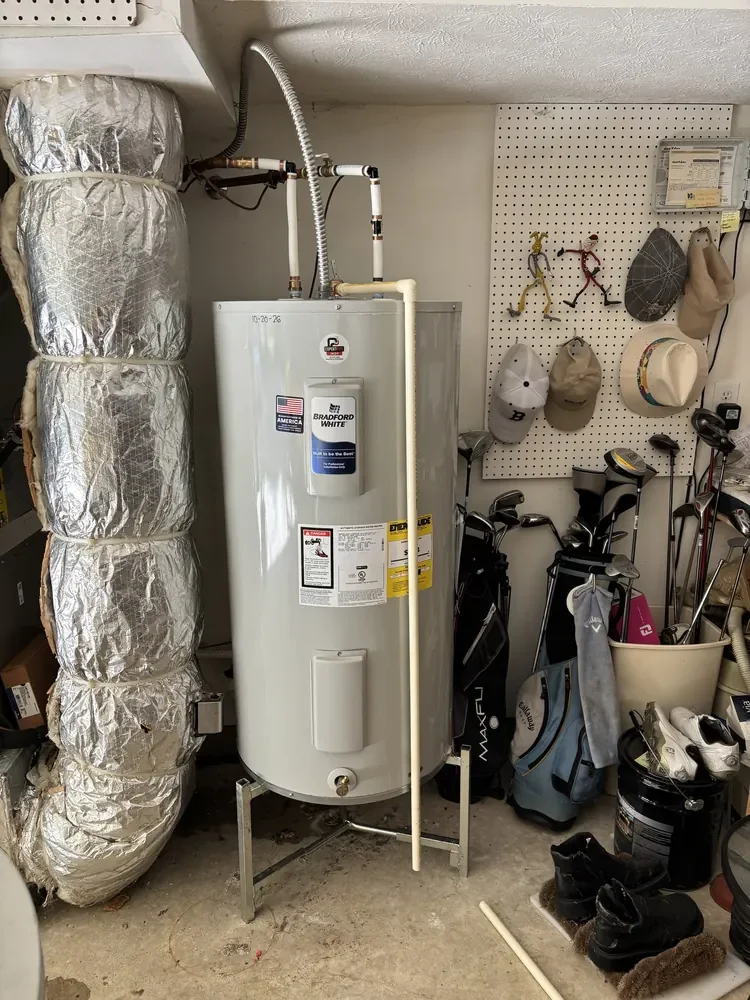
A water heater usually quits at the worst time: a cold shower on a school morning or a puddle on the basement floor. In Meridian Hills, Nora and Broad Ripple, replacing one often involves a little more than a straight swap, because older homes come with older venting, gas lines and shutoffs. Here's what to expect and how to plan ahead.
Repair or replace?
Not every problem means a new water heater. A bad thermocouple, igniter, heating element or thermostat can often be repaired quickly. We'll recommend replacement only when it's the better value, and we'll tell you why. These are the signs that usually point that way:
Age. Many tank water heaters wear out somewhere past the ten-year mark, and hard water can shorten that.
A leaking tank. Water coming from the tank itself, not a fitting, means the lining has failed. That can't be repaired.
Rusty hot water. Brown or rusty water from the hot side only often means the tank is corroding inside.
Rumbling and popping. Heavy sediment makes the unit work harder and can damage the tank bottom over time.
Running out of hot water. If your household has grown or the unit was undersized to begin with, a larger tank or a tankless unit may make more sense.
If your water heater is leaking right now
Shut the cold water valve on the pipe above the heater. If it won't turn, shut off the main water valve for the house.
For a gas unit, turn the gas control knob to off. For an electric unit, switch off its breaker.
Keep people and pets away from hot water on the floor, and move stored items out of the way.
If you smell gas, leave the house and call your gas utility or 911 from outside.
Then call or text us. Same-day replacement is often available.
What North Indy homes often need
Homes in 46240, 46260, 46228 and 46208 range from mid-century ranches to large older homes with finished basements. A few things come up regularly on water heater installs here:
Venting. Many older gas water heaters vent into a masonry chimney. If the furnace was upgraded to a high-efficiency model, the water heater may now be venting alone into a chimney that's too large for it, which can cause drafting problems. We check this on every gas install.
Expansion tanks. Current code typically calls for a thermal expansion tank on closed systems. Older installs often don't have one.
Shutoff valves and connectors. Old gate valves and corroded connectors are worth replacing while the water is already off.
Access. Tight basement stairs and finished utility rooms affect how the old unit comes out and the new one goes in.
Gas supply. Tankless units need a properly sized gas line, which older homes don't always have.
Tank or tankless?
Tank water heaters
We install Bradford White gas and electric tank water heaters. A tank is a simple, reliable choice, it fits where your old one was, and it's usually the quickest replacement.
Tankless water heaters
We install Navien tankless water heaters. They heat water on demand, so you don't run out during back-to-back showers, and they free up floor space. Going tankless often means new venting and sometimes a larger gas line, so we'll look at your setup before recommending it.
What's included and what affects the price
Every install includes the permit, hauling away your old unit, and testing the new one before we leave. The price depends on the fuel type and size, the venting, any code updates your setup needs, and how easy the space is to work in. Your plumber looks at all of that on site and gives you options with a price before any work starts.
Current offers: $500 off any tankless water heater installation and $50 off any tank water heater installation. If you already have a written estimate from another licensed plumber for the same install, our 10% price match beats it by 10%. Offers can't be combined with the price match.
When to call us
If your water heater is leaking, making new noises or past its prime, get it looked at before it fails. Learn more about our water heater repair and replacement service, or see how we serve North Indianapolis neighborhoods like Meridian Hills, Nora, Broad Ripple and Williams Creek.
FAQ
Do I need a permit to replace a water heater?
Yes. A water heater replacement requires a permit in Indianapolis and the surrounding communities. We pull it for you as part of the install.
Can you replace my water heater the same day?
Often, yes. Standard tank replacements are frequently done the same day you call. Tankless conversions may take a little more planning if the venting or gas line needs work.
Do you haul away the old water heater?
Yes. Removing and disposing of your old unit is part of every installation.
How long should a new water heater last?
That depends on the unit, your water and how it's maintained. Flushing a tank once a year and keeping hard water in check with a softener both help it last longer.
Can I use the tankless discount and the price match together?
No. You can use either the $500 off tankless or $50 off tank offer, or the 10% price match, whichever works best for you.
Need hot water back? Call or text (317) 731-3028, or see our Indianapolis water heater service page.

Emergency Plumbing in Indianapolis: A Calm, Step-by-Step Playbook
Plumbing emergencies rarely happen at a convenient hour. The good news is that the first few minutes are mostly about two things: stopping the water and staying safe. Here's the plan we walk homeowners through on the phone, followed by what to do for the emergencies we see most around Indianapolis and Hamilton County.
The first five minutes
Shut off the water. Turn the main shutoff valve clockwise until it stops. If it's a lever, turn it so it sits across the pipe.
Stay clear of electricity. Don't walk through standing water near outlets, appliances or extension cords. If you can reach the breaker panel safely, shut off power to the wet area.
Protect your things. Move rugs, electronics and boxes out of the water's path and put down towels.
Take photos. A few pictures of the damage and the source help with any insurance claim later.
Call or text us. Texts to (317) 731-3028 are answered 24/7. If water is actively leaking and you can't stop it, call so we can talk you through it.
If you smell gas, skip everything above. Leave the house, don't flip switches, and call your gas utility or 911 from outside.
Where is the main shutoff?
Most Central Indiana homes with a basement have the main valve on the front wall, where the water line comes in from the street. In slab and crawl space homes, look in the utility closet near the water heater, in the garage, or in the crawl space by the entry. Homes on well water usually have a valve near the pressure tank. Find yours now, while nothing is wrong, and tag it so anyone in the house can find it.
The emergencies we see most
Burst washing machine hose
Rubber washer hoses get brittle with age and can let go without warning. Shut the valves behind the washer or the main, then unplug the machine. We replace failed hoses with braided stainless lines and can add a leak sensor so you hear about the next problem right away.
Frozen or burst pipes
Indiana's freeze-thaw swings are hard on hose bibs and pipes in outside walls, garages and crawl spaces. If a pipe is frozen but not leaking, open the faucet and gently warm the pipe with a hair dryer. Never use an open flame. If it has split, shut off the main and call us.
Sewer backup
Water coming up through a basement floor drain or several fixtures backing up at once points to the main sewer line. Stop running water, don't flush, and keep people away from the wastewater. We clear the line, run a camera to find the cause and walk you through your options.
Leaking water heater
Shut the cold water valve above the heater. Turn the gas control knob to off for a gas unit, or switch off the breaker for an electric one. Water from the tank itself usually means the tank has failed. Same-day replacement is often available.
Sump pump failure during a storm
Check that the pump is plugged in and the breaker hasn't tripped, and look for a stuck float. If water is rising and the pump won't run, call us. A battery backup pump is the best protection for the next storm.
After the fix
Once the water is stopped and the repair is done, we test our work before we leave. Then we'll suggest a few simple upgrades that keep the next surprise small:
Label your main shutoff and water heater valves
Replace rubber supply lines with braided stainless
Check water pressure and add a pressure-reducing valve if it runs high
Install leak alarms near the water heater, washer and sump pit
Add a battery backup to your sump pump
Ask about a backwater valve if your basement has backed up during big storms
When to call us
If water is going where it shouldn't, you can't stop it, or you're unsure whether it can wait, reach out. Our emergency plumbing team covers Indianapolis, Carmel, Fishers, Zionsville, Brownsburg and nearby Hamilton and Boone County homes. For hidden leaks, like a damp wall or a warm spot on the floor, see our leak detection and repair service. Your plumber gives you options and a price before any work starts, even at night.
FAQ
How do I know if it's a real emergency?
If water is actively leaking and you can't stop it, sewage is backing up, you have no water at all, or you smell gas, treat it as an emergency. A slow drip or one slow drain can usually wait for a regular appointment.
Can I keep using water while the sewer is backing up?
No. Every flush, shower or load of laundry adds to the backup. Stop using water until the line is cleared.
Should I call my insurance company or a plumber first?
Stop the water first, then take photos. Call a plumber to fix the source, then contact your insurance company. Keep any invoices and photos for the claim.
My main shutoff won't turn. What now?
Don't force it with a wrench, since old valves can break. Call us and we'll help you find another way to shut the water off, such as the valve at the curb or meter.
Will I know the price before you start after hours?
Yes. Your plumber explains what they found and gives you options with a price before any work begins, day or night.
Water where it shouldn't be? Call or text (317) 731-3028, or visit our emergency plumber page.

Seasonal Plumbing Checklist for Hamilton and Boone County Homes
Central Indiana can go from subzero wind chills to sticky, corn-sweat humidity in a few months, and your plumbing feels every swing. A little seasonal attention keeps most of the expensive surprises away. Here's the checklist we'd give a neighbor in Carmel, Westfield, Zionsville or Whitestown.
Fall: get ready for the first hard freeze
Fall is the most important season on this list. Most frozen hose bibs we see could have been prevented in ten minutes.
Disconnect garden hoses before the first hard freeze. A hose left on traps water in the faucet, even on a frost-free hose bib.
If your outdoor faucets have an inside shutoff, close it and open the outside faucet to let the line drain.
Add insulated covers to outdoor faucets for extra protection.
Insulate exposed pipes in garages, crawl spaces and along outside walls.
Flush your tank water heater, or have a tankless unit descaled, before the heavy holiday use starts.
Find your main shutoff and make sure it turns. Tag it so everyone in the house knows where it is.
Winter: keep pipes warm and water moving
Keep the thermostat steady, including overnight and when you travel.
On the coldest nights, open cabinet doors under sinks on outside walls so warm air reaches the pipes.
Let a faucet on an outside wall drip during a deep cold snap.
If a faucet only trickles on a frigid morning, the pipe may be partly frozen. Open the faucet and warm the pipe gently with a hair dryer. Never use an open flame.
Set your water heater to about 120°F. It's hot enough for everyday use and helps prevent scalding.
Keep an eye on the sump pump during thaws, when melting snow can fill the pit quickly.
Spring: storm season prep
Spring rains test every basement in Hamilton and Boone counties. Get ahead of them.
Test your sump pump by slowly pouring a bucket of water into the pit until the float lifts and the pump kicks on. It should empty the pit and shut off on its own.
Make sure the sump discharge line is clear and drains away from the house.
Consider a battery backup pump. Storms and power outages tend to arrive together.
Extend downspouts so they drop water well away from the foundation.
If your basement floor drain backed up last year, schedule a sewer camera inspection before the rainy season.
Check outdoor faucets for leaks the first time you turn them back on. A split pipe from winter often shows up now.
Summer: maintenance while it's easy
Replace rubber washing machine hoses with braided stainless lines.
Look under sinks and around toilets for slow drips, stains or soft spots.
Check the water heater's pressure relief valve discharge pipe for drips and the area around the base for moisture.
Keep softener salt topped up. Hard water across Hamilton County is hard on heaters, faucets and fixtures all year.
Run plenty of cold water when using the disposal, especially during cookout season.
Year-round habits
Pour a cup of water into rarely used floor drains every month or two so the trap doesn't dry out and let sewer smell in.
Keep grease out of the sink.
Consider leak alarms near the water heater, washer and sump pit.
Know where your sewer cleanout is and keep its cap snug.
For homes on well and septic
Many homes in outlying parts of Boone and Hamilton counties are on private wells and septic systems. Add these to your list:
Listen for a well pump that turns on and off rapidly, which can point to a pressure tank or switch problem.
Watch for pressure that drops off during showers.
Keep the area around the well head clear and protected from freezing.
Stay on top of septic pumping and avoid flushing wipes or grease.
When to call us
If you'd like a hand with any of this, we can walk through your home, check the items that matter most and fix anything that needs it. Our sump pump installation and repair service covers pumps and battery backups, and our well and septic team handles pressure tanks, pumps and switches. Your plumber gives you options and a price before any work starts.
FAQ
When should I disconnect my hoses and shut off outdoor faucets?
Before the first hard freeze, which in Central Indiana usually arrives sometime in late fall. It's easiest to do it when you put the lawn mower away for the season.
Do frost-free hose bibs still need attention in winter?
Yes. A frost-free faucet only works if the hose is disconnected so the water can drain out. Leave the hose on and it can freeze and split inside the wall.
How often should I test my sump pump?
Test it a few times a year, and always before spring storm season. If it's more than several years old or struggles to empty the pit, have it checked.
How often should I flush my water heater?
Once a year for most tank water heaters. With hard water, a tankless unit benefits from regular descaling too.
What water pressure is too high?
If your pressure sits above 80 PSI, fixtures and supply lines wear out faster and you may hear pipes bang. A pressure-reducing valve brings it down to a safer range.
Want a seasonal checkup? Call or text (317) 731-3028, or request a visit online.

Roots, Offsets and Clogs: Drain Help in Zionsville and Brownsburg
Zionsville and Brownsburg have some of the prettiest tree-lined streets in the area, and those trees have roots that love old sewer lines. Add Central Indiana clay soil that shifts with every freeze and thaw, and you get three problems we find again and again on camera: roots, offsets and sags. Here's what each one means and how we deal with it.
Is it one drain or the main line?
Start by noticing which fixtures are acting up.
One slow drain is usually a local clog: hair in a tub, grease in a kitchen line. A cleaning at that fixture typically fixes it.
Several fixtures at once, especially on the lowest floor, points to the main sewer line. A toilet that gurgles when the washer drains, or water rising in a basement floor drain, are classic signs.
Sewer smell can mean a dry floor drain trap, a loose cleanout cap or a problem in the line. Pour a cup of water into rarely used floor drains first. If the smell stays, call us.
The three usual suspects
Roots
Older homes, like many in Zionsville's village area, often have clay tile sewer lines laid in short sections. Each joint is a place where a little moisture escapes and a root can find its way in. Once inside, roots grow into a net that catches paper and waste until the line backs up.
Offsets
An offset is a joint where one section of pipe has shifted up, down or sideways from the next. Clay soil that swells when wet and shrinks when dry is a common cause. The lip at the joint catches debris and slows flow.
Sags, or bellies
A belly is a low spot where the pipe has settled and water sits instead of flowing downhill. Newer homes in Brownsburg and Whitestown have PVC lines that resist roots, but they can still sag if the soil under them settles after construction. Waste collects in the low spot and builds into a clog.
How we find the real cause
Clear the line. We open the main at a cleanout and get it flowing, using a cable machine or hydro-jetting depending on what's in there.
Run a camera. A sewer camera shows exactly what's happening inside the pipe, and a locator tells us where and how deep the problem sits in your yard.
Mark the spot. If a repair is needed, we mark the location so any digging is focused on the problem section.
Show you the video. You see what we see and get your options explained in plain language.
Your repair options
Not every line needs to be dug up. We'll recommend the simplest fix that will actually last.
Cleaning and maintenance. For light root intrusion in a line that's otherwise in decent shape, regular cleaning may be all you need.
Spot repair. If one joint or section is the problem, Shawn and our excavation crew dig at the marked spot, replace that section with new code-approved pipe and restore the area.
Line replacement. When a line has roots, offsets and sags along much of its length, replacing it is often the better value. We'll show you on the video why we think so.
After a repair, we run the camera again so you can see the finished work before we backfill.
Habits that help
Keep grease, wipes and paper towels out of drains, even wipes labeled flushable.
Use hair catchers in tubs and showers.
Run plenty of cold water with the disposal so food makes it to the main.
Know where your outdoor cleanout is and keep the cap snug so rainwater and critters stay out.
Skip chemical drain openers. They rarely reach a main line clog and can be hard on older pipes.
When to call us
Repeat backups, gurgling toilets and slow drains on the lowest floor are worth a camera inspection before they turn into a flooded basement. Our drain cleaning and repair team and sewer line repair crew serve Zionsville, Brownsburg, Whitestown and nearby Boone and Hendricks County homes. Your plumber gives you options and a price before any work starts.
FAQ
Will roots come back after you clean the line?
Usually, because the joint they came through is still open. Cleaning buys time, and many homeowners schedule it regularly. Repairing the damaged section stops the problem at its source.
Do you have to dig up my whole yard?
No. The camera and locator pinpoint the problem, so digging is limited to the section that needs repair. We restore the area when we're done.
Why does my newer home have sewer problems?
Newer PVC lines resist roots, but soil can settle after construction and create a sag. Construction debris left in the line can also cause early clogs. A camera inspection will show which one it is.
Who is responsible for the sewer line outside my house?
In most places the homeowner is responsible for the line from the house to the public sewer connection. Your town or utility can tell you exactly where your part ends.
Is my repair covered by a warranty?
Yes. Every job comes with our 12-month workmanship warranty, and our techs are licensed, insured and background-checked.
Drains backing up? Call or text (317) 731-3028, or see how we serve Zionsville homeowners.
